
In this blog, we discover how UPS systems protect distribution centres, courier facilities, and warehouse automation from power interruptions, voltage instability, and generator changeovers.

Across South Africa, large logistics facilities rely on conveyor systems, warehouse management platforms, barcode scanning infrastructure, dispatch software, refrigeration areas, fleet coordination systems, and tightly synchronised workflows.
As explored in our last article, distribution and logistics facilities are increasingly affected by power quality issues that extend beyond complete outages. Distribution centre UPS systems play an increasingly important role in protecting this infrastructure and supporting stable warehouse automation during utility instability and generator changeovers.
In these facilities, power interruptions are only one part of the risk. Voltage sag, harmonic distortion, transient instability, generator changeovers, and erratic grid supply can interrupt automated processes long before a complete outage occurs. Even brief electrical disturbances can halt conveyor synchronisation, interrupt dispatch activity, create scanning errors, and trigger recovery procedures that delay fulfilment and delivery schedules.
Online double-conversion UPS systems are increasingly used to maintain stable electrical conditions and reduce disruption caused by power quality problems across logistics operations.
Why Distribution Centres Are Vulnerable to Power Quality Problems
Distribution centres operate differently from many traditional industrial facilities. Large sites typically combine operational infrastructure and digital systems under one roof. Conveyor equipment, automated handling systems, refrigeration infrastructure, charging stations, warehouse control platforms, communications networks, and high-density electronic loads all place different demands on the electrical supply.
Generator changeovers present a particular challenge. Although backup generation restores supply, short periods of voltage fluctuation and frequency instability during transfer can interrupt sensitive automation systems before generator output stabilises. Conveyor controls, barcode systems, warehouse software, and dispatch platforms may all require recovery and resynchronisation afterwards.
In many facilities, returning to normal throughput takes significantly longer than restoring electrical supply. Three-phase online double-conversion UPS systems are commonly deployed to isolate critical automation, control, and dispatch infrastructure from unstable supply conditions while maintaining stable operation throughout utility disturbances and supply transitions.
How UPS Systems Protect Warehouse and Distribution Operations
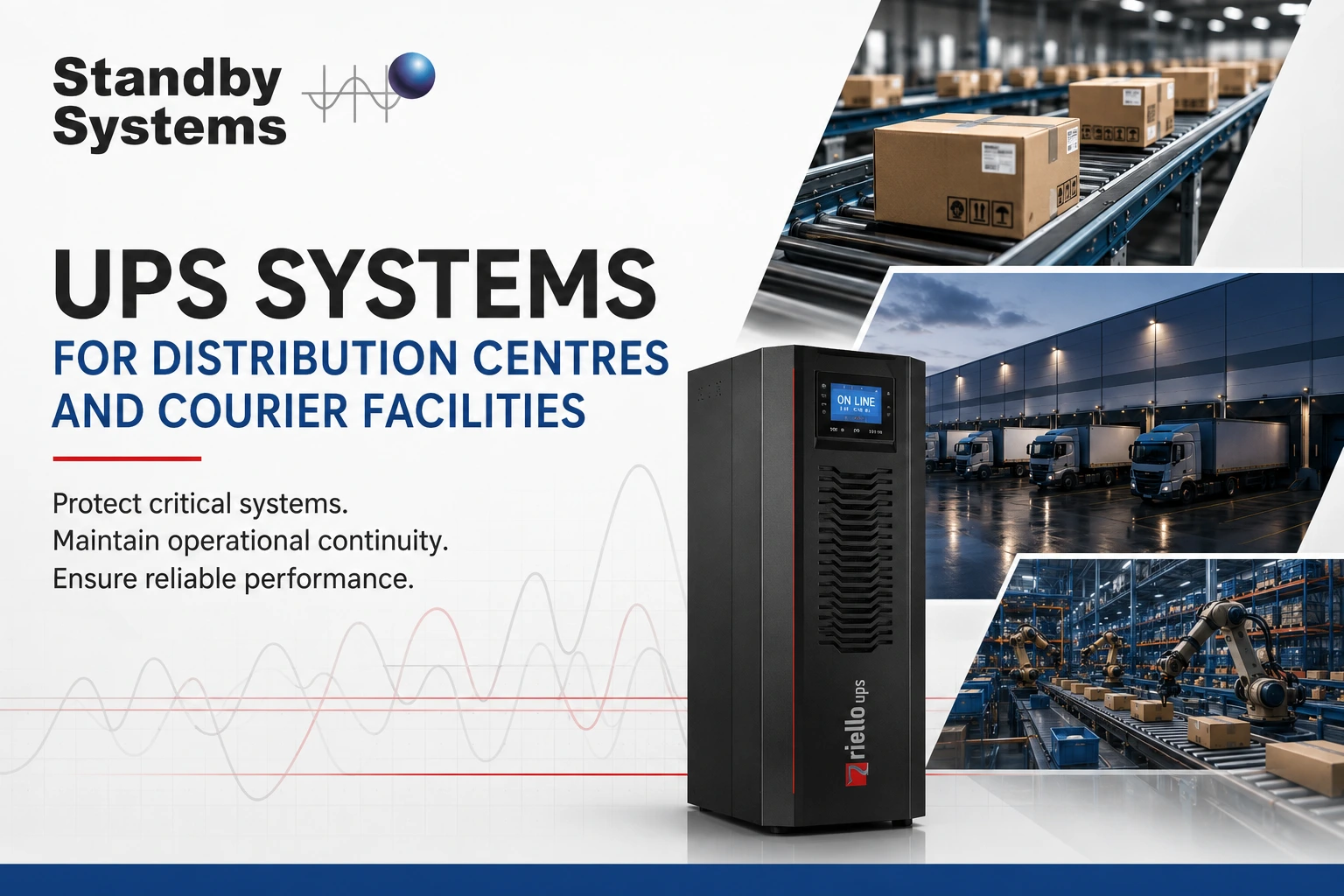
Rather than placing entire warehouse loads on battery, UPS design in logistics facilities focuses on protecting the systems that maintain operational control and visibility.
These commonly include:
- Warehouse management systems (WMS)
- Conveyor and sortation controls
- PLC infrastructure
- Barcode and scanning platforms
- Dispatch and scheduling systems
- Fleet communication infrastructure
- Monitoring and compliance systems
- Healthcare and temperature-controlled logistics infrastructure
- Network and server platforms
- Control rooms and operator workstations
This approach allows large operational loads to remain generator-supported while control systems and critical digital infrastructure continue operating under stable electrical conditions.
Facilities requiring scalable three-phase protection commonly implement systems such as:
UPS selection depends on capacity requirements, redundancy strategy, runtime objectives, and the characteristics of the connected load.
UPS Installations by Standby Systems in South African Distribution and Courier Facilities
Standby Systems supports logistics, fulfilment, and distribution operations across South Africa with UPS solutions designed around operational requirements and facility resilience.

Pick n Pay Main Distribution Centre, East Rand
High-volume distribution facilities operate under constant pressure to maintain throughput while coordinating large volumes of inventory movement.
At Pick n Pay’s main East Rand distribution centre, Riello Master HE (MHE) UPS systems in 100 kW and 300 kW configurations support critical electrical infrastructure underpinning day-to-day distribution activity.
Learn more about the Riello Master HE range.

Takealot Facilities Across South Africa
E-commerce fulfilment relies on continuous coordination between warehouse automation, order processing platforms, and dispatch systems.
Across multiple Takealot sites throughout South Africa, including the East Rand main distribution centre, Riello Multi Sentry (MST), Master MPS, and Sentryum UPS systems support reliable electrical performance across fulfilment and dispatch operations.
Explore:

DHL Distribution Operations, East Rand
Courier operations depend on accurate sorting, uninterrupted processing, and real-time visibility throughout the dispatch cycle.
DHL’s East Rand distribution centre integrates multiple installations featuring Riello Master MPS systems together with Riello Multi Sentry (MST) configurations to support continuous processing and operational visibility.
View:

DSV Distribution and Healthcare Logistics Operations
Healthcare logistics introduces additional sensitivity to electrical disturbances due to monitoring systems, controlled conditions, and operational compliance requirements.
Across DSV facilities, including DSV Healthcare operations, UPS protection combines Riello and PureLine platforms ranging from 6 kVA through to larger Master Plus installations, aligned to the operational requirements of each site.
Explore additional Standby Systems UPS solutions.
Why UPS Protection Matters in Modern Distribution Centres
Distribution centres and courier operations increasingly depend on electrical stability to maintain throughput, protect fulfilment performance, and support reliable service delivery.
When critical systems lose stability, the consequences extend beyond downtime. Delays affect service levels, place pressure on customer commitments, reduce operational efficiency, and create ripple effects throughout the supply chain.
UPS infrastructure helps protect the systems that keep goods moving, maintain visibility, and support consistent operational performance.
For guidance on selecting UPS infrastructure for logistics, warehousing, fulfilment, courier, and distribution operations, contact Standby Systems.