

In this blog, we investigate what causes UPS capacitor failure and how it can be prevented. Capacitors are essential UPS components with a finite service life. Like batteries and cooling fans, they deteriorate through normal use, with higher operating temperatures accelerating the ageing process.
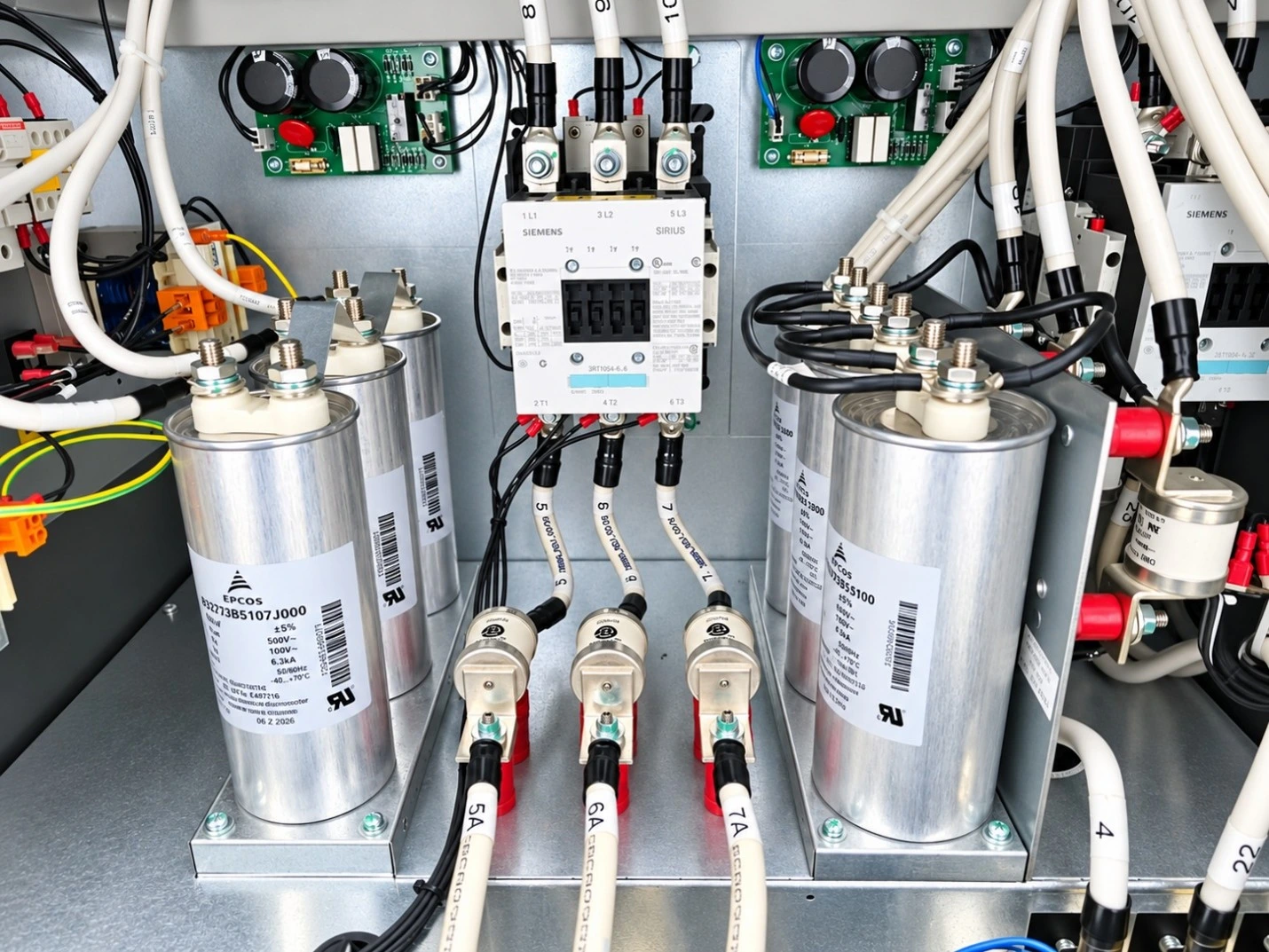
As capacitors deteriorate, their filtering performance declines. On the DC link, increased ripple voltage places additional stress on the batteries and accelerates their ageing. Deteriorating output filter capacitors can also distort the AC sine wave, potentially affecting sensitive equipment connected to the UPS system. Depending on the location and severity of the fault, the UPS may trigger an alarm, transfer to bypass or lose its ability to protect the critical load.
Regular preventative maintenance can identify signs of capacitor deterioration, allowing components to be replaced before UPS performance or the critical load is affected. However, ignoring warning signs increases the risk of serious failure. Ageing capacitors may operate at higher temperatures, accelerating further deterioration and potentially leading to rupture or, in severe cases, fire.
Standby Systems maintains Riello, Pureline and other commercial and industrial UPS systems throughout South Africa and selected countries in the wider SADC region.
What Do Capacitors Do in a UPS System?
A capacitor stores electrical charge between two conductive electrodes separated by an insulating dielectric. Its capacitance, measured in farads (F), describes how much charge it holds per volt applied. The energy it stores is measured in joules and rises with the square of the voltage, so a capacitor bank on a high-voltage DC bus holds a significant amount of energy.
In an online double-conversion UPS, capacitors smooth, filter and store energy in three main areas of the power section:
- AC input capacitors form part of the input filter and, in UPS systems with an IGBT rectifier, the power factor correction stage. They help keep the current drawn from the mains sinusoidal and assist in absorbing some incoming transients.
- DC capacitors sit on the DC bus between the rectifier and the inverter. They smooth the rectified voltage, filter the AC ripple superimposed on it for the connected batteries and provide short-term energy storage that supports the inverter during load changes and the transfer to battery.
- AC output capacitors form part of the inverter’s output filter. They shape the switched inverter output into a clean sine wave for the critical load.
Smaller capacitors are also fitted to the UPS’s control and power-supply circuit boards.
DC bus capacitors are usually aluminium electrolytic types, while AC filter capacitors are usually metallised film types. These technologies have different ageing characteristics. For a broader explanation of capacitor types and their roles, see our guide to capacitors in UPS systems.
What Causes UPS Capacitors to Fail?
High operating temperatures
Heat is the main cause of premature capacitor ageing. As a general rule of thumb for aluminium electrolytic capacitors, a 10 °C rise in operating temperature roughly halves service life. The exact effect depends on the capacitor and its operating conditions. Heat comes from the room, from neighbouring components and from inside the capacitor itself. A failed air-conditioning unit, a blocked air filter or a faulty cooling fan can therefore shorten capacitor life considerably.
Electrical stress and excessive ripple current
Ripple current flowing through a capacitor’s internal resistance generates heat inside it. Depending on the UPS design and where a capacitor sits in the circuit, its electrical stress can increase with high loading, with harmonic currents drawn by the load, or when another capacitor in the same bank has failed, and the remaining ones carry its share. Supply transients and overvoltages add further stress, particularly to input capacitors.
Ageing and component deterioration
Ageing mechanisms differ between capacitor technologies. Electrolytic (DC) capacitors contain a liquid electrolyte that slowly evaporates through the seal, faster when hot. As they dry out, capacitance falls and internal resistance rises, so they generate more heat and age faster still. Film (AC) capacitors do not dry out in this way. Their dielectric clears small internal faults by “self-healing”, but each event removes a little electrode area, so capacitance falls gradually over years of service.
Poor environmental or operating conditions
Dust, humidity and corrosive atmospheres can accelerate capacitor deterioration by restricting cooling and damaging connections or insulation. These conditions are particularly relevant to mining and heavy industrial installations, where maintaining clean air filters, effective ventilation and suitable operating temperatures is essential.
How Can You Tell When a UPS Capacitor Is Failing?
Some capacitor deterioration can be seen, but much of it can only be measured. DC bus capacitors can hold a dangerous charge after the UPS has been switched off, so internal inspection and testing should be left to trained UPS service engineers.
Visible or physical signs
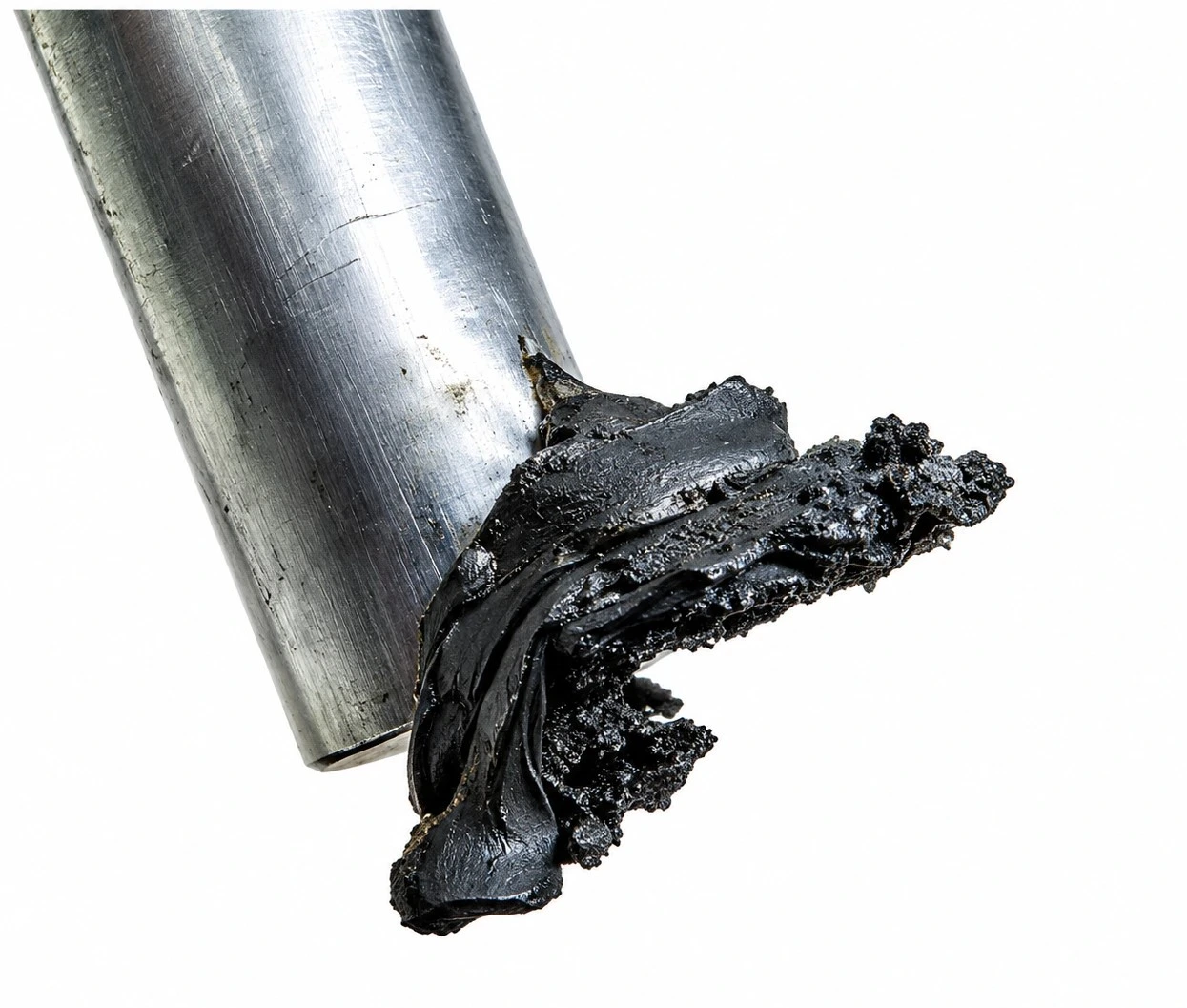
- Electrolyte or oil leaking from the seal or terminals
- Bulging or deformed casings, or a raised pressure vent
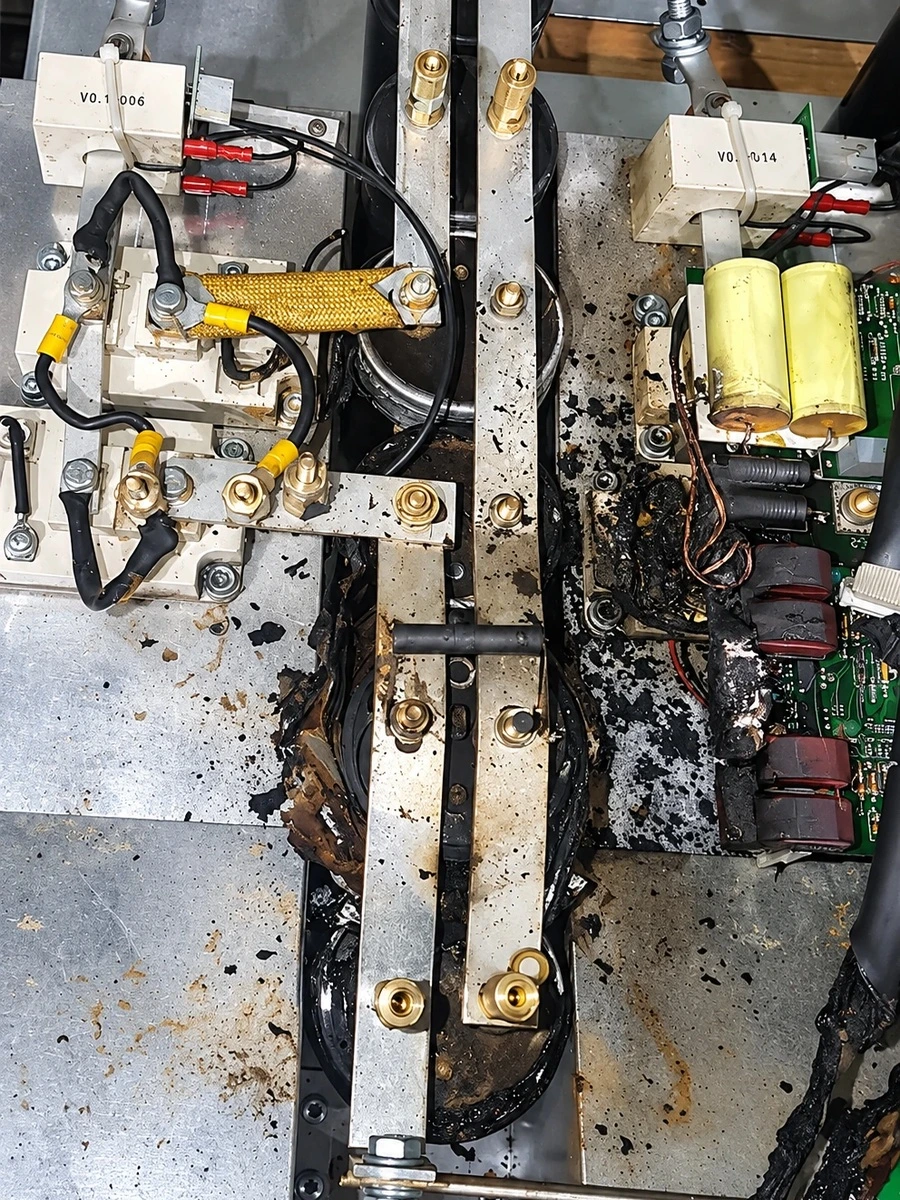
- Discoloured or scorched wiring and terminals, a sign of overheating connections
Signs identified through professional testing
- Measured capacitance that has drifted from the rated value.
- Increased ripple voltage on the DC bus.
- Hot capacitors or connections identified through thermal (infrared) imaging, where appropriate.
- Changes in UPS readings and alarms recorded over successive maintenance visits.
A capacitor that fails open circuit may show no visible signs of damage.
What Happens When a UPS Capacitor Fails?
The effect depends on which capacitor fails, how it fails and how the UPS is designed. A UPS may keep running with one degraded capacitor, or it may alarm, transfer to bypass or, in the worst case, drop the load.
Three common capacitor failure conditions
| Condition | What happens | How it usually shows |
| Open circuit | The capacitor stops contributing to the circuit. In a bank, the remaining capacitors take on more ripple current and age faster. | Often no visible sign; found through testing |
| Short circuit | The dielectric breaks down. The capacitor may leak, vent or, in severe cases, rupture, and protective devices may operate. | Leakage, deformation, alarms or a sudden fault |
| Progressive deterioration | Capacitance falls and internal resistance rises over time until the capacitor no longer filters effectively. | Drifting capacitance, rising ripple, heat |
Effects on the UPS and the critical load
- Increased waveform distortion. Degraded output filter capacitors let more harmonic distortion and noise reach the critical load. Degraded input capacitors can reduce input filtering and, depending on the UPS design, power factor correction.
- DC bus instability. Degraded DC capacitors increase ripple on the DC bus, stressing the rectifier, inverter and batteries. Riello UPS notes that capacitor failure can also damage battery strings.

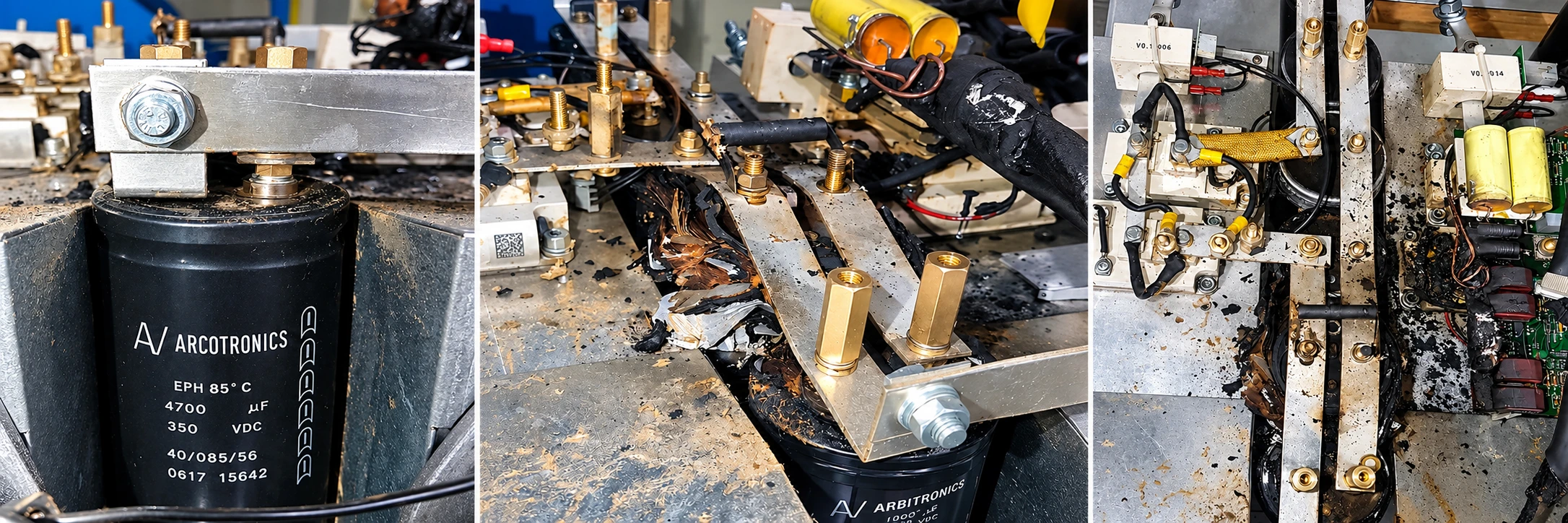
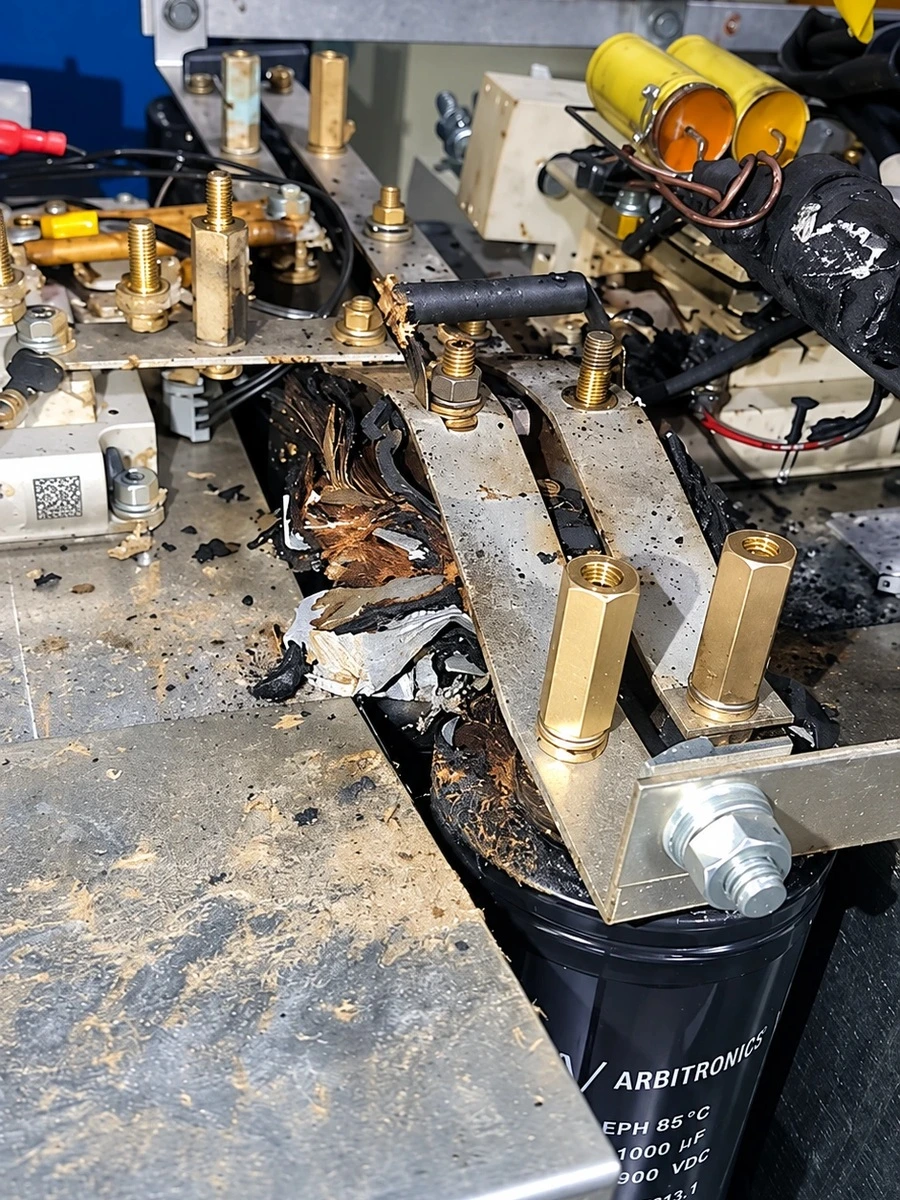
Serious electrical faults can damage capacitor assemblies and nearby UPS components. - Transfer to bypass or loss of output. If the UPS detects a fault it cannot ride through, it may transfer the load to bypass, where it runs on raw mains without battery protection. Whether bypass is available, and how the transfer takes place, depends on the UPS design and the conditions at the time. If DC capacitors fail during a mains failure, when the inverter depends entirely on the DC bus, the critical load can be lost.
- Damage to other components. A short-circuit failure can damage nearby power semiconductors, fuses, wiring or circuit boards, increasing the repair cost.
- Possible effects on parallel systems. In some failure scenarios, a capacitor fault in one unit of a parallel UPS configuration may cause that unit to drop out of the parallel group, reducing redundancy.
- Operational disruption. Unplanned downtime, lost production, emergency call-outs and urgent sourcing of parts all add to the cost of an unplanned failure.
How Long Do UPS Capacitors Last?

According to Riello UPS, capacitors can provide up to 10 years of service under favourable operating conditions, although this is at the upper end of their expected lifespan. Riello recommends proactive replacement between 4 and 8 years.
Based on its experience maintaining commercial and industrial UPS systems, Standby Systems generally recommends preventative capacitor replacement every 6–8 years, provided operating conditions are suitable. The appropriate interval depends on the capacitor technology, electrical load, ripple current and operating temperature
The manufacturer’s recommendations for the specific model, such as a Riello Master HP or Multi Sentry, should also guide the interval.
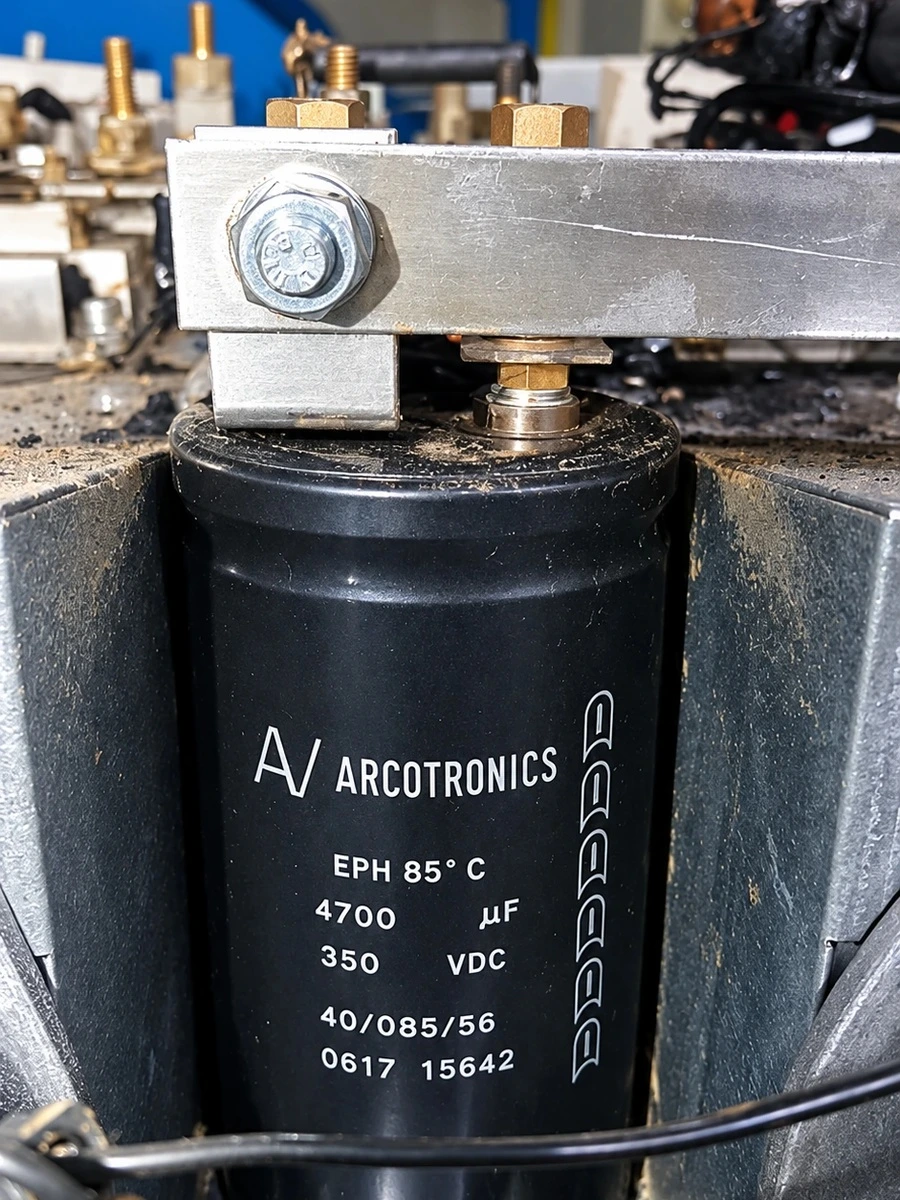
Rather than replacing capacitors at a fixed age regardless of condition, or waiting for them to fail, plan replacement according to the manufacturer’s guidance and the condition assessments made during maintenance, allowing time to source the correct parts. Higher operating temperatures and electrical stresses can shorten capacitor service life, making regular condition assessments particularly important in demanding installations.
How Does Preventative Maintenance Reduce the Risk of Capacitor Failure?
Standby Systems’ service engineers assess capacitor condition as part of scheduled UPS maintenance. Depending on the UPS model, a maintenance visit includes:
- Visual and mechanical checks for leakage, deformation, discoloured terminals and loose connections.
- Electrical measurements, including DC ripple and, where appropriate, capacitance.
- Thermal analysis to find hot capacitors and connections is an optional preventative measure.
- Checks on cooling fans, air filters and ambient conditions that affect capacitor temperature.
- Analysis of the recorded readings and UPS event logs after the visit, compared with previous results.
These comparisons help engineers identify deteriorating capacitors and schedule their replacement.
Standby Systems recommends preventative UPS maintenance at least once a year, although twice-yearly servicing is generally preferred. For heavily utilised systems or installations operating under demanding conditions, maintenance may be required up to four times a year.
Although some failures develop without warning, routine maintenance and remote UPS monitoring can help reduce the risk of unexpected downtime. Our UPS preventative maintenance and servicing also covers batteries, static transfer switches and other backup power equipment.
Frequently Asked Questions
Can a UPS continue operating with a failing capacitor?
Yes, depending on the location and nature of the failure. A degraded capacitor within a bank may not immediately affect UPS operation, whereas a short circuit could trigger an alarm or transfer to bypass. Continued operation does not necessarily mean the UPS can maintain its performance under changing load or supply conditions.
Should all UPS capacitors be replaced when one fails?
It is best practice to replace the complete group or bank rather than only the failed capacitor. Capacitors in the same bank are usually the same age and have run at the same temperature and load, so the others are likely to be nearing the end of their life too. A new capacitor fitted among aged ones can also carry an uneven share of the current. Follow the UPS manufacturer’s recommendations and your service engineer’s assessment of the remaining capacitors.
Can UPS capacitor failure be detected before the critical load is affected?
Regular maintenance can identify developing problems through visual inspections, capacitance measurements and ripple monitoring. Thermal imaging may also be used where appropriate. However, sudden failures can occur without warning, making preventative maintenance and appropriate system monitoring important.
What is the delivery time of a capacitor?
Capacitors have a limited storage life and can deteriorate even when not in use. Depending on global demand and availability, delivery times for replacement capacitors can be as long as three to six months. Planning replacements well in advance helps avoid delays that could leave a UPS system unable to protect its critical load.
Protect Your Critical Load with Planned UPS Maintenance
Standby Systems provides preventative maintenance and technical support for Riello and other commercial and industrial UPS systems across South Africa and the SADC region, at sites including data centres, hospitals and mines. Our service engineers assist businesses in identifying deteriorating components and planning maintenance to minimise the risk of unexpected downtime.
Book a UPS capacitor condition assessment or discuss a preventative maintenance contract with our service team.
Service: service@standbysystems.co.za | +27 11 794 3406
Sales: sales@standbysystems.co.za | +27 11 794 2541
Dedicated UPS line: 082 450 2361
Contact us online or find us on Facebook, LinkedIn, Instagram and YouTube.