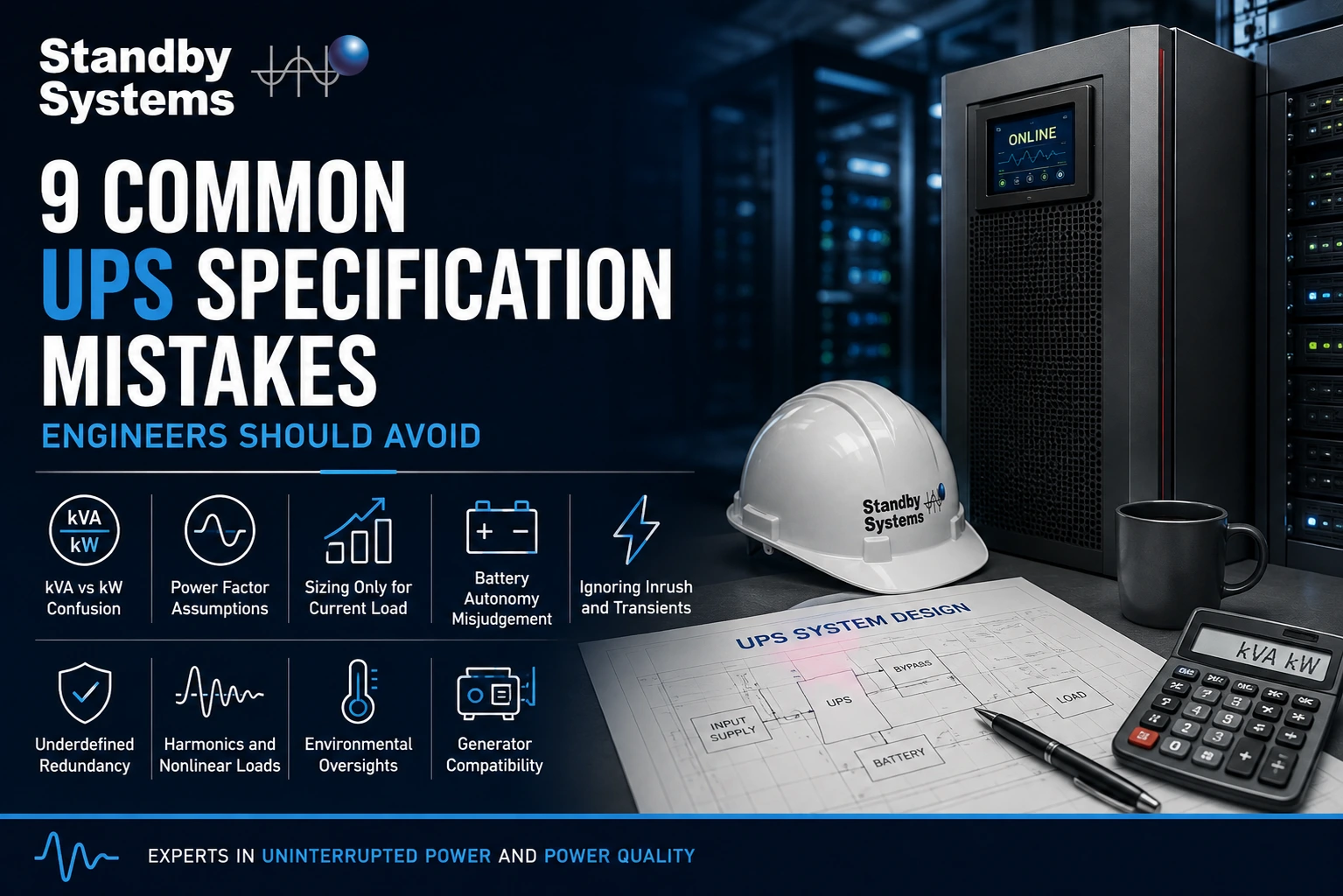
Common UPS specification mistakes engineers should consider during UPS system design.
In our experience, we have encountered nine common UPS specification mistakes, so we put together this guide to help engineers avoid them.
Specifying an uninterruptible power supply (UPS) involves considerably more than matching a UPS rating to the connected load. Load type, battery autonomy, operating environment, redundancy and future expansion can all affect how the UPS system should be sized and configured.
An oversized UPS can add unnecessary cost, while an undersized system may not adequately support the load under actual operating conditions. For consulting engineers, the challenge is to look beyond the nameplate rating and understand how the UPS will perform as part of the wider electrical system.
Nine areas deserve particular attention during UPS system design.
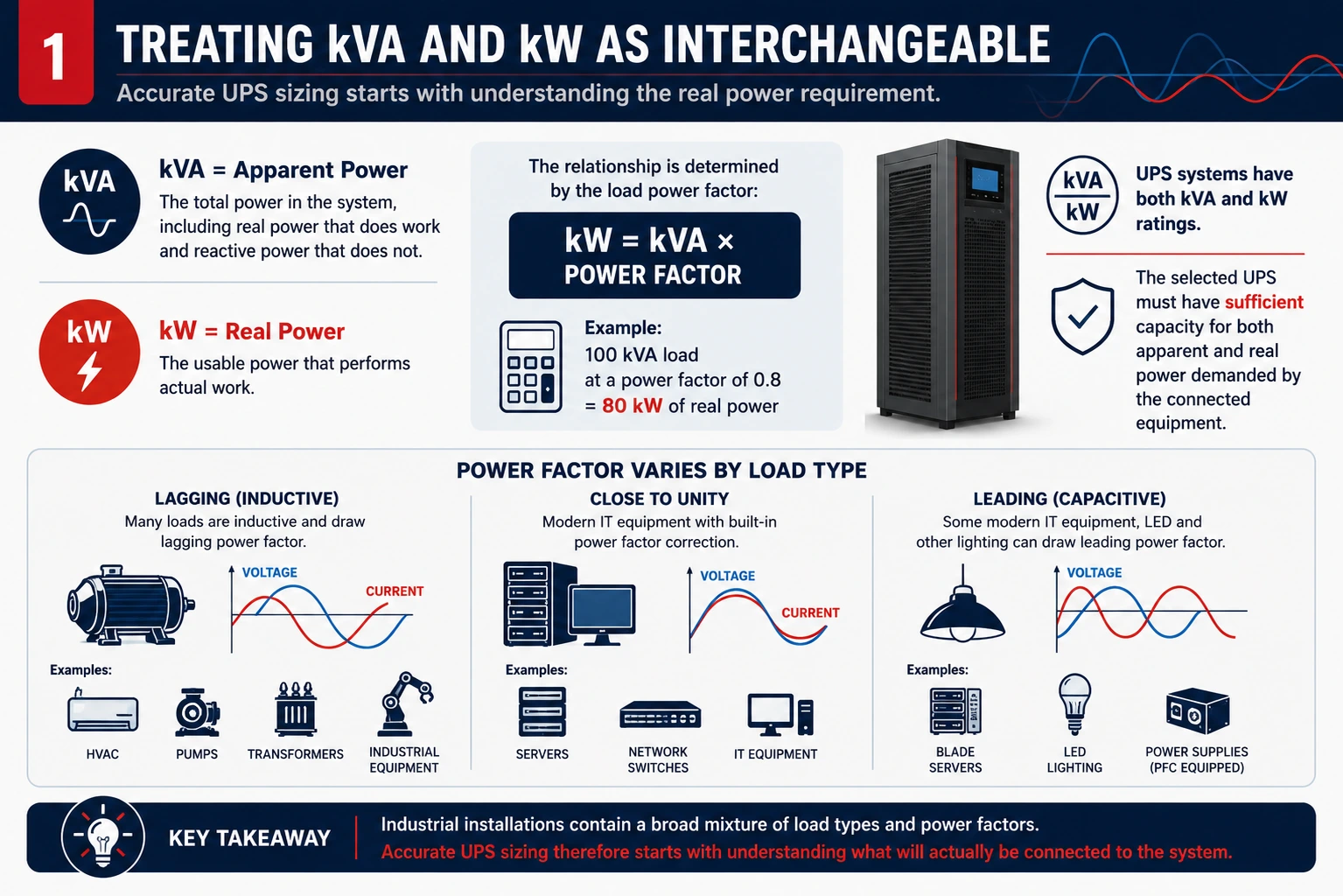
One of the most fundamental UPS sizing mistakes is basing the system capacity on kVA without adequately considering the real power requirement in kW.
kVA represents apparent power, while kW represents real power. The relationship between the two is determined by the load power factor:
kW = kVA × power factor
A 100 kVA load at a power factor of 0.8, for example, represents 80 kW of real power.
UPS systems have both kVA and kW ratings, and both need to be taken into account. The selected UPS must have sufficient capacity for both the apparent and real power demanded by the connected equipment.
Modern IT equipment and other loads fitted with built-in power factor correction can operate close to unity power factor, but many other loads are inductive and will draw lagging power factor.
On the other hand, some modern IT equipment, such as blade servers, and some types of LED and other lighting can even run with a leading capacitive power factor. Industrial installations, however, will usually contain a much broader mixture of load types and power factors.
Accurate UPS sizing therefore starts with understanding what will actually be connected to the system.
Applying a generic power factor to an entire installation can produce an inaccurate UPS specification.
Servers, control systems, instrumentation, medical equipment, motors and other electronic or industrial equipment do not necessarily place the same demands on a UPS.
Where several load types are being supported, the system design should reflect the equipment that will actually be connected rather than relying solely on a nominal total kVA figure.
This is particularly important in industrial facilities, data centres and healthcare environments, where a single UPS may support equipment with very different load profiles.
A UPS designed too closely around today’s load may leave little capacity for future expansion.
Additional production equipment, servers, automation or instrumentation can increase demand during the operating life of the UPS. If the system does not allow for reasonable growth, the facility may require premature expansion or replacement.
That does not mean simply selecting a substantially larger UPS. Excessive oversizing can increase capital cost and may cause the system to operate outside its preferred load range. It can also increase medium-term operating costs for components such as batteries, fans and capacitors, which have a finite service life.
Expected growth should instead influence the initial capacity and UPS configuration. Depending on the application, this may include parallelability, provision for additional modules or a redundancy strategy that allows the system to expand as demand increases.
Battery autonomy is sometimes treated as a standard requirement such as 10, 15 or 30 minutes. The appropriate runtime depends on what must happen after the incoming supply is lost.
How long must the equipment remain operational? Is the UPS bridging the time until an alternative supply becomes available? Does a process need time to reach a safe state? Is an orderly shutdown required? Is the UPS supporting a solar inverter load where the solar inverter power drifts on and off throughout the day, causing the UPS battery to cycle repeatedly and reducing its service life?
These questions should determine the required autonomy.
Battery sizing must also account for the actual UPS load, battery type and configuration, and expected operating temperature. A battery bank selected against an arbitrary runtime requirement may not deliver the expected autonomy later in its service life. In fact, every battery technology has a specified design life based on a number of parameters, with 80% of its original capacity accepted as the point at which the battery has reached end of life.
Normal operating current does not always tell the full story.
Motors, transformers and certain industrial loads can draw significantly higher current during startup or changes in operating state. These short-duration demands can be considerably higher than the normal running load.
If the UPS is sized only according to steady-state demand, a high inrush current may cause it to reach its current limit or transfer to mains and back unexpectedly. This can result in “hunting” or cause the UPS to lock out on bypass, requiring repeated manual resets.
Starting current, transient demand and UPS overload capability should therefore be assessed where the connected equipment is likely to impose significant short-duration load power draw.
“Provide N+1 redundancy” is a familiar requirement in UPS designs, but N+1 alone does not define how resilient the complete installation will be.
An N+1 arrangement generally provides sufficient additional capacity for the required load to remain supported if one UPS unit or module becomes unavailable. The actual level of redundancy, however, also depends on the system configuration, bypass arrangement, batteries, switchgear and load distribution.
The specification should define what the system must continue to support during a failure or planned maintenance event. That requirement can then determine whether the appropriate design uses parallel UPS systems, modular redundancy or another configuration.
Many modern electrical loads do not draw current as a clean sinusoidal waveform. Power electronic equipment can introduce harmonic currents that affect the electrical system and influence UPS selection.
A design based only on total kVA and kW can therefore miss an important part of the load profile.
The design should account for nonlinear loads, current harmonic distortion and their effect on the UPS and upstream electrical infrastructure.
Modern online double-conversion UPS systems help maintain power quality for protected equipment, but the characteristics of the connected load and the installation still need to be assessed when selecting and configuring the UPS.
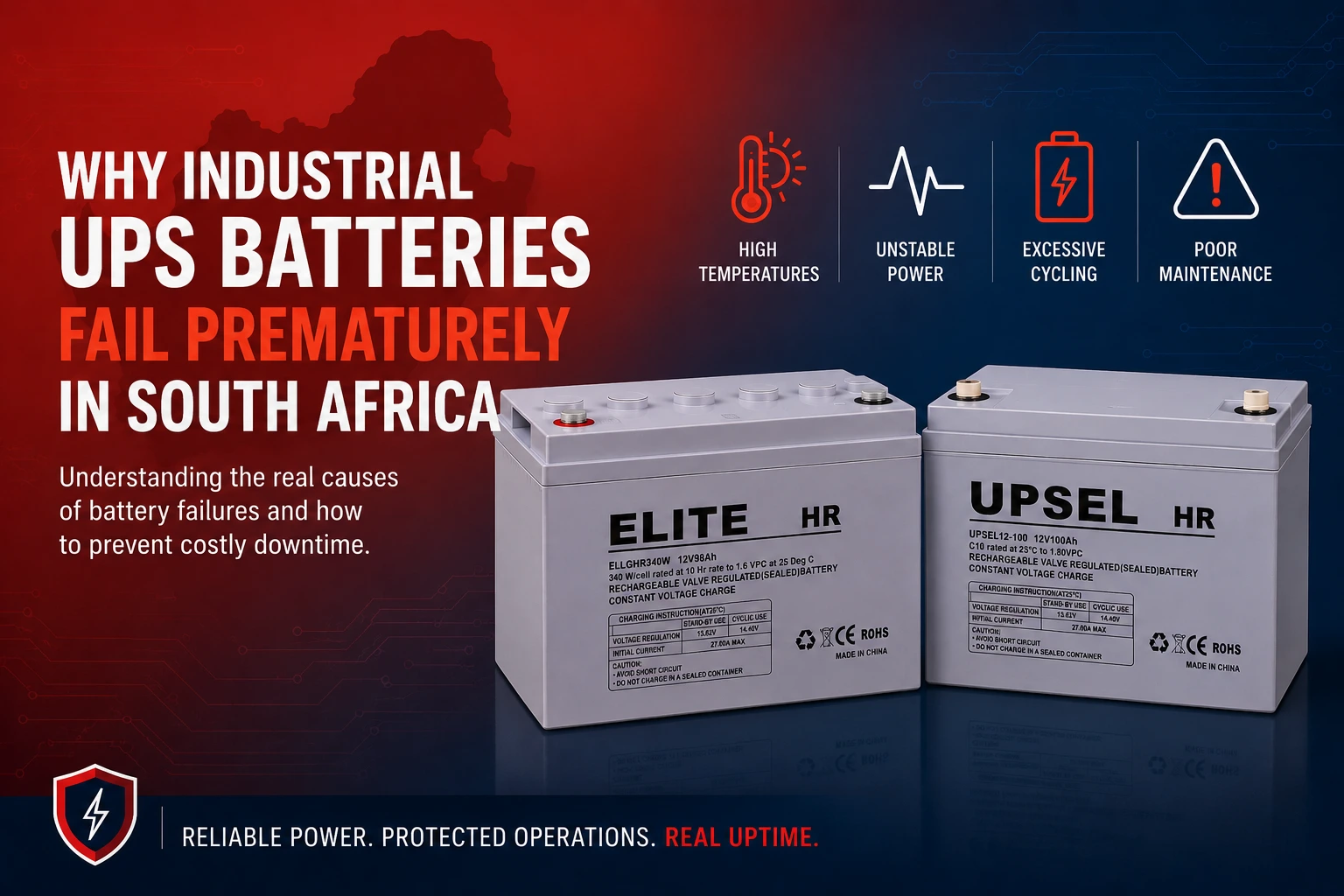
Ambient temperature can have a significant effect on UPS battery performance and service life.
Battery ratings are based on defined operating conditions. Sustained high temperatures in electrical rooms, industrial plants, mining operations or poorly ventilated installations can accelerate battery ageing considerably.
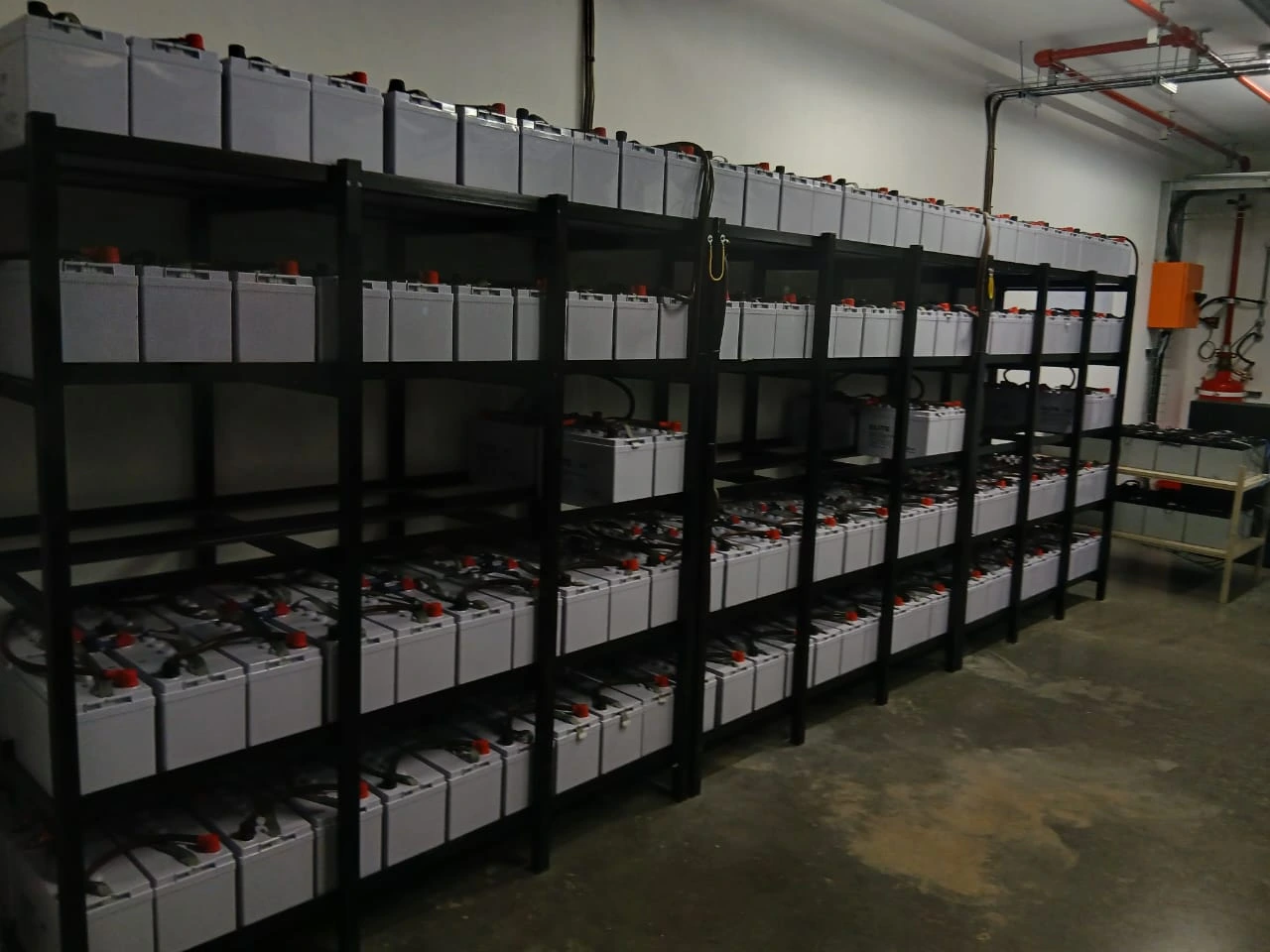
This is particularly relevant to UPS batteries, including valve-regulated lead-acid (VRLA) batteries. Battery location, ventilation, air conditioning and temperature monitoring should form part of the installation planning rather than being addressed after the battery system has been selected.
South African conditions can vary considerably between installations. A battery bank operating in a temperature-controlled data centre has a very different operating environment from one installed in a hot industrial or mining facility.
Where a UPS operates with a standby generator, the two systems need to be assessed together from the design stage.
Generator sizing, voltage and frequency stability, UPS input power factor, input harmonic distortion and changes in load can all influence how the systems behave when the incoming supply changes.
Problems can arise when the UPS and generator are selected independently and expected to work together after installation.
Assessing compatibility before equipment is selected allows the UPS and standby supply to be designed as part of the same power protection system, reducing the risk of problems during transfer and operation.
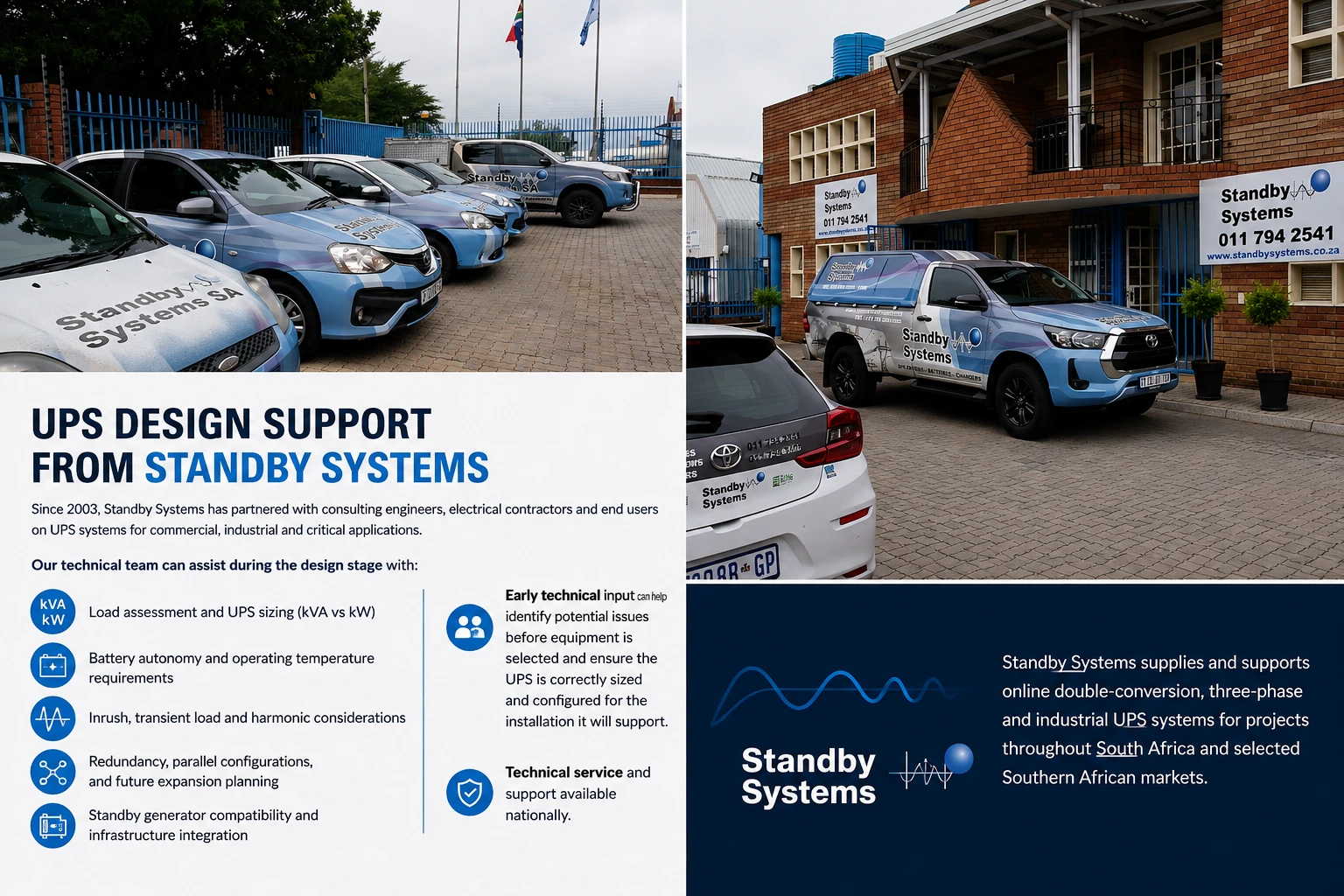
Since 2003, Standby Systems has worked with consulting engineers, electrical contractors and end users on UPS systems for commercial, industrial and critical applications.
Our technical team can assist during the design stage with:
Early technical input can help identify potential issues before equipment is selected and ensure the UPS is correctly sized and configured for the installation it will support.
Standby Systems supplies and supports online double-conversion, three-phase and industrial UPS systems for projects throughout South Africa and selected Southern African markets, with technical service and support available nationally.
If you are designing a UPS system for a new installation, expansion or replacement project, speak to Standby Systems early in the process. Our technical team can work with consulting engineers to assess the load, autonomy, redundancy, operating conditions and future capacity requirements before the UPS system and battery configuration are finalised.
Contact Standby Systems, visit our website, or find us on Facebook, LinkedIn, Instagram, and YouTube.
In this blog, we detail why generator-supported loads still need online UPS protection. Many organisations…
Southern Africa is at a turning point with its power production, but we are not…
In this blog, we discover how UPS systems protect distribution centres, courier facilities, and warehouse…
In this blog, we uncover five more industries where power instability creates immediate operational risk.…
Standby Systems shares what SECUREX 2026 confirmed about UPS power protection in South Africa’s security…
In this blog, we investigate why industrial UPS batteries fail prematurely in South Africa, because…