Reliable UPS solutions engineered to protect South African businesses against outages, poor power quality, and generator transitions.
Originally published: 16 December 2024
Updated: 30 July 2026
This article serves as Standby System’s complete guide to uninterrupted power and power quality in South Africa, where the power grid has reached a turning point. Years of ageing infrastructure, deferred maintenance, and rising seasonal demand have left the network under sustained pressure, and industry estimates put the investment needed to modernise it in the hundreds of billions of rand. Municipal instability makes things worse, with local distribution networks often struggling even when the national grid holds steady.
For years, the conversation around backup power in South Africa began and ended with load shedding. That’s no longer the whole picture. While prolonged outages remain a real concern, businesses today face a broader range of electrical risks: voltage instability, generator transitions, harmonic distortion, and poor power quality that never shows up as a full blackout but quietly damages equipment anyway. Protecting critical systems now requires an understanding of power quality as a whole.
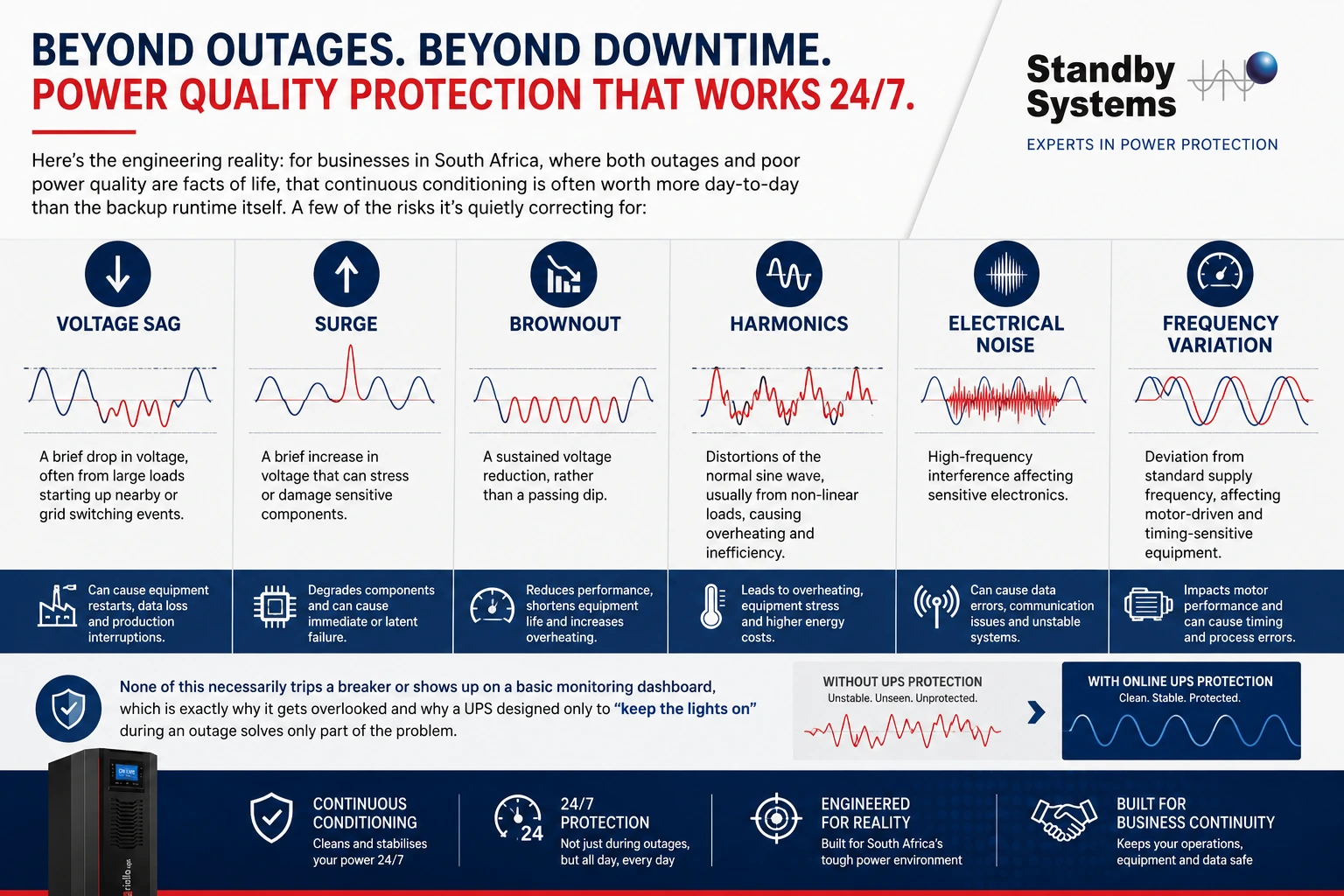
Most businesses plan for the outage they can see: the moment the lights go out. Few plan for the risks that arrive without warning. Voltage sags during grid switching, harmonic distortion from nearby industrial equipment, frequency drift on strained municipal networks, and transient spikes when supply is restored. None of this announces itself, but it degrades electronics, shortens equipment life, and corrupts data just as effectively as a blackout. Often more so, because it goes unnoticed until something fails.
Having a reliable Uninterruptible Power Supply remains essential. Modern online UPS systems do far more than bridge the gap during an outage: in double-conversion (online) topology, incoming AC is converted to DC and back to a clean, regulated AC output before it reaches connected equipment, so sags, surges, harmonics, and frequency variation get corrected in real time, not only during a blackout, but throughout every hour the UPS is in circuit.
Here’s the engineering reality: for businesses in South Africa, where both outages and poor power quality are facts of life, that continuous conditioning is often worth more day-to-day than the backup runtime itself. A few of the risks it’s quietly correcting for:
None of this necessarily trips a breaker or shows up on a basic monitoring dashboard, which is exactly why it gets overlooked and why a UPS designed only to “keep the lights on” during an outage solves only part of the problem.
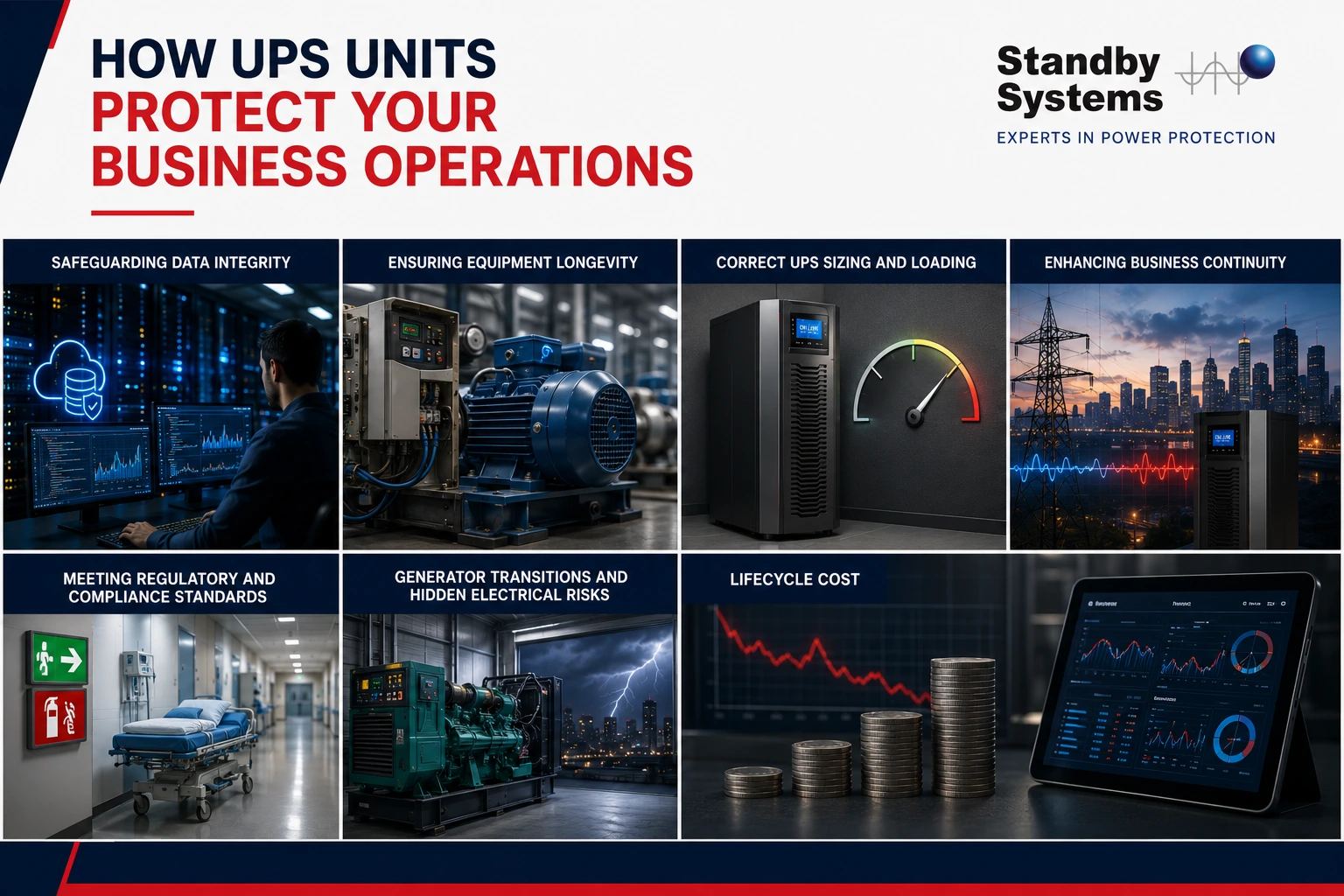
Power interruptions disrupt business processes fast: productivity losses, data corruption, physical damage to sensitive equipment. For businesses that depend on continuous power, including data centres, manufacturing plants, and healthcare facilities, even a short interruption can be severe.
Full outages aren’t the only culprit. Voltage sags and brownouts starve equipment of the power it needs to run properly, often causing resets or errors rather than an obvious failure. Transient spikes degrade components over time even when no single event causes visible damage. A properly specified UPS addresses all of this, not just the risk of losing power entirely, so critical operations continue, and sensitive equipment stays protected.
Data is one of the most valuable assets a business holds, and power failures remain one of the most common causes of data loss or corruption. A UPS provides the buffer needed for a safe, controlled shutdown of IT equipment, protecting data integrity when outages hit. That matters most for businesses handling large volumes of data, where downtime or corruption carries real operational and reputational cost.
Frequent power interruptions and voltage fluctuations wear down electrical equipment over time, shortening its lifespan and pushing up maintenance costs. A UPS regulates the power reaching connected equipment, protecting it from spikes and dips, keeping operations smooth and extending the working life of the equipment it protects.
|
For any business, downtime carries a cost: not just lost revenue but also disrupted customer relationships and, in some industries, safety risks. True business continuity isn’t just about surviving an outage; it’s about maintaining operational resilience through it. That means a UPS that bridges the gap cleanly at the moments that matter most, especially during the transition to a generator, when standby power comes online and switching itself can introduce its own instability if not managed properly. It’s about whether critical processes stay protected through the transition, and how quickly things recover once grid power returns.
In some industries, a reliable power backup system isn’t just good practice; it’s a regulatory requirement. Healthcare, finance, and telecommunications providers must meet strict standards for service availability and reliability, and a properly specified UPS helps them meet compliance requirements without the legal and financial fallout of falling short. Riello’s CPS (critical power systems) range, including the CSS Sentinel Tower, CSS Sentryum, and CSS Master UPS, is built to strict EU standards for supplying emergency protection loads such as fire systems or medical applications.
Riello CPS highlights (compliant to EN 50171 safety standards for emergency equipment):
One of the least discussed risks in backup power planning is the transition itself: the moment a facility switches from grid power to generator, or back again. Many organisations install generators expecting them to solve power interruptions, without realising that the transition between utility power and generator power can itself introduce electrical disturbances. This switch is rarely instantaneous or clean: voltage and frequency can fluctuate briefly as the generator alternator increases speed to nominal during start-up and synchronises, and a poorly managed transition can introduce exactly the kind of transient events and frequency instability that damage sensitive equipment.
It’s a risk we see repeatedly across the industries we work with, from hospitals where equipment can’t tolerate even a momentary disruption to logistics and warehousing operations running automated systems around the clock. A properly specified UPS, sized and configured with the generator transition in mind, bridges this gap cleanly, so the switchover itself never becomes the vulnerability it’s meant to protect against.
For facilities using electro-mechanical backup power systems such as diesel generators, Riello MPT, MHT, and MHE UPS systems, paired with VRLA or lithium battery solutions, can also support peak-lopping strategies. Operating in parallel with the grid, they help reduce peak demand costs for factories and other large industrial users.
Purchase price is only one part of the total cost of ownership. Preventing downtime, protecting equipment from wear, and avoiding data loss all feed into a return on investment that plays out over the system’s working life, typically 10 to 15 years for a well-specified unit. Standby Systems offers products across different budgets, so businesses of any size can get effective power protection without overpaying for capacity they don’t need.
The choice between transformer-based and transformerless (transformer-free) architecture has a real impact on long-term cost and reliability, not just the price on the quote.
Transformerless systems are generally more affordable upfront, but they lack an output transformer, which provides galvanic isolation and improves the system’s ability to handle waveform distortion and high-demand loads, such as plasma cutters, arc furnaces, medical imaging equipment, and motor-driven industrial loads.
Transformer-based systems cost more initially but tend to have lower operating expenses over their lifespan and greater robustness. Here’s the practical reality, particularly in ageing data centres: transformer-based systems experience fewer faults and less associated damage than transformerless alternatives, resulting in lower maintenance costs and fewer disruptions. It’s a genuine trade-off, not a clear winner either way; selection depends on the load profile and criticality of the application.
Battery choice is often treated as an afterthought, but it shapes how a UPS performs when it matters. Runtime is one consideration; battery resilience, operating conditions, and expected service life matter just as much: how the battery holds up under repeated cycling, South African ambient temperatures, and years of use.
VRLA batteries remain a cost-effective, well-understood option for many applications. Lithium-based batteries, increasingly using LFP (lithium iron phosphate) chemistry, offer longer cycle life, better temperature tolerance, and a smaller footprint, at a higher upfront cost. Battery selection should be driven by the operational requirements of the facility rather than chemistry alone: a facility expecting frequent, short outages has different needs to one planning for occasional, extended runtime.
Every facility has its own combination of operational priorities, electrical risks, and budget considerations. A suitable UPS solution is therefore rarely about selecting a product in isolation; it’s about designing a power protection strategy that fits the application.
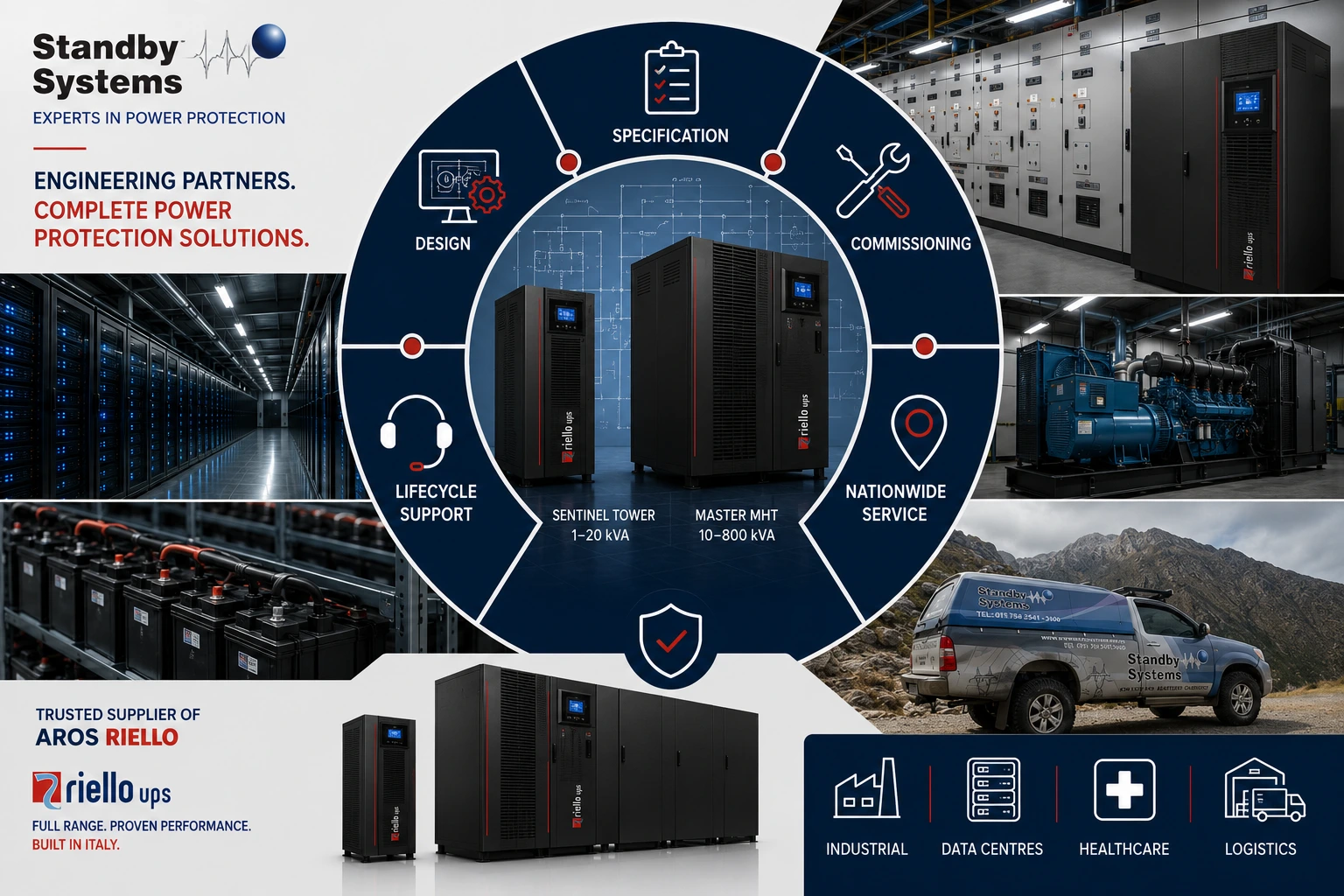
Standby Systems works as an engineering partner, not just a supplier.
That starts with specification: understanding your load profile, criticality, and risk exposure before recommending a solution.
It continues through design and commissioning, ensuring the UPS, battery, and generator transition (where applicable) are configured to work together as a system, not as separate purchases.
And it doesn’t end at installation: our maintenance programmes and nationwide support network mean your power protection is looked after for the life of the system, not just the day it’s switched on.
As the sole inland distributor for Riello UPS products in South Africa, Standby Systems supplies the full AROS Riello range, renowned for efficiency and durability across single-phase and three-phase applications, from small business installations to large industrial operations.
Different facilities place very different demands on their power infrastructure. An office, a hospital, a manufacturing plant, and a hyperscale data centre rarely require the same UPS architecture. The most suitable approach comes down to load size, criticality, and the equipment being protected.
Single-phase UPS units suit smaller loads, such as offices, retail environments, individual server racks, or workstations, where simplicity and cost-effectiveness matter more than scale.
Three-phase UPS systems are built for larger industrial, commercial, and medical applications, where higher power loads and zero tolerance for downtime are the norm. These range from transformer-based inverter technology, such as the Master HE, MPT, and MHE, to transformerless options like the Sentryum, MST, and NXE. Transformer-based units offer greater robustness for high-demand or distortion-prone applications; transformerless units offer a lower upfront cost, higher efficiencies and hence less power losses, and a smaller footprint for less demanding loads.
Where upfront cost is the deciding factor, Riello’s transformer-free range spans from compact single units to large modular systems: the Sentryum (10–120 kVA), Multi Sentry (160–200 kVA), NXE (250–800 kW, designed for data centres), and the modular Multipower and Multipower 2 ranges for scalable deployments. For smaller loads, the Sentinel Tower and Sentinel Dual can run stand-alone or in parallel for N+1 redundancy. Full specifications are on our product pages.
Choosing a UPS isn’t just about matching a kVA rating to a load. A sound strategy weighs a wider set of factors together:
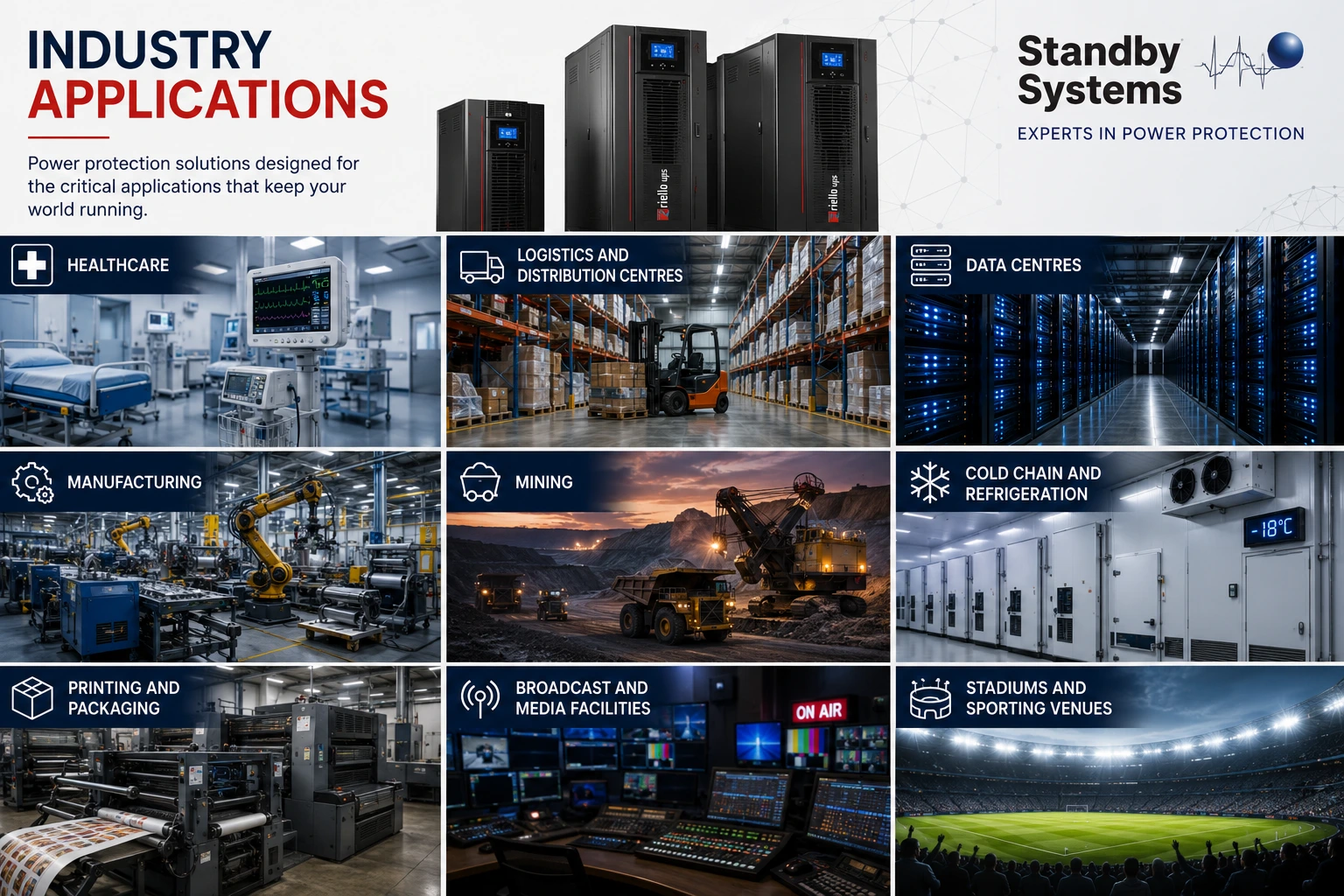
Get these right together, and the UPS earns its keep for the life of the system rather than just on day one. The industries below show what that looks like in practice.
Every industry faces its own combination of electrical risks, operational priorities, and compliance requirements. Explore how these challenges affect a range of sectors, together with practical guidance on selecting, deploying, and maintaining UPS systems.
Standby Systems has spent years earning its place as a trusted name in South Africa’s UPS industry. The company combines product supply with specification, design, commissioning, and long-term support, backed by deep technical expertise, particularly in three-phase UPS systems. With one of the country’s largest UPS warehouse stockholdings based in Johannesburg, Standby Systems provides efficient nationwide distribution and support. That combination means we can move quickly when it matters and specify correctly the first time.
South Africa’s power challenges aren’t going away, but with a properly specified solution in place, they don’t have to threaten your operations either. Standby Systems provides the tools and technical expertise to keep your business running, safeguarded against both outages and the quieter risks of poor power quality.
Contact our team to discuss the right UPS and battery strategy for your business: 011 794 3406 (services), 011 794 2541 (UPS units for sale), or 082 450 2361 (UPS enquiries).
In our experience, we have encountered nine common UPS specification mistakes, so we put together…
In this blog, we detail why generator-supported loads still need online UPS protection. Many organisations…
In this blog, we discover how UPS systems protect distribution centres, courier facilities, and warehouse…
In this blog, we uncover five more industries where power instability creates immediate operational risk.…
Standby Systems shares what SECUREX 2026 confirmed about UPS power protection in South Africa’s security…
In this blog, we investigate why industrial UPS batteries fail prematurely in South Africa, because…