Online UPS protection maintains continuous, stable power while a standby generator starts and stabilises.
In this blog, we detail why generator-supported loads still need online UPS protection.
Many organisations invest in standby generators believing they have eliminated the risk of power interruptions. While they are an essential part of any backup power strategy, they are only one component of a complete power protection system supporting essential electrical supplies in hospitals, data centres, commercial buildings, and other critical operations.
In mines, water treatment plants, and other critical operations, restoring electrical supply is only part of the challenge. Essential equipment also requires continuous, stable, high-quality power before, during, and after a utility failure.
This is where an online double-conversion UPS plays a vital role. An online double-conversion UPS works alongside the generator, ensuring sensitive equipment remains protected throughout the entire power event.
A standby generator is designed to restore electrical supply when the utility supply fails. As soon as an outage is detected, it will normally start automatically by means of an Automatic Mains Failure (AMF) panel. Once the rotor achieves an operational speed of around 1500 RPM (depending on the number of poles it has), it will generate its rated voltage at its rated frequency. In the case of South Africa, Zimbabwe, and Mozambique, this is 400 VAC, three-phase, 50 Hz. It will then automatically transfer its connected load from the mains supply contactor to the generator output contactor and hence power the load.
This process takes 15 seconds to a couple of minutes depending on the system design, but during start-up and stabilisation, the load supply will be off. For servers, industrial control systems, medical and laboratory equipment, communications networks, and other critical loads, even a brief interruption can result in equipment shutdowns, system resets, production losses, or data corruption.
An online UPS is installed between the generator load feed and the load itself and eliminates the power interruption during start-up by continuously supplying power to the load from its inverter, either from the input AC supply or the battery. During a utility failure, the UPS batteries immediately support the inverter while the generator starts and stabilises. Connected equipment continues to receive uninterrupted power throughout the transition. The result is true power continuity rather than simply restored electrical supply.
An online double-conversion UPS continuously converts incoming AC power to DC before converting it back to a clean, regulated AC output. Because the inverter is always supplying the load, connected equipment is electrically isolated from disturbances on the incoming supply.
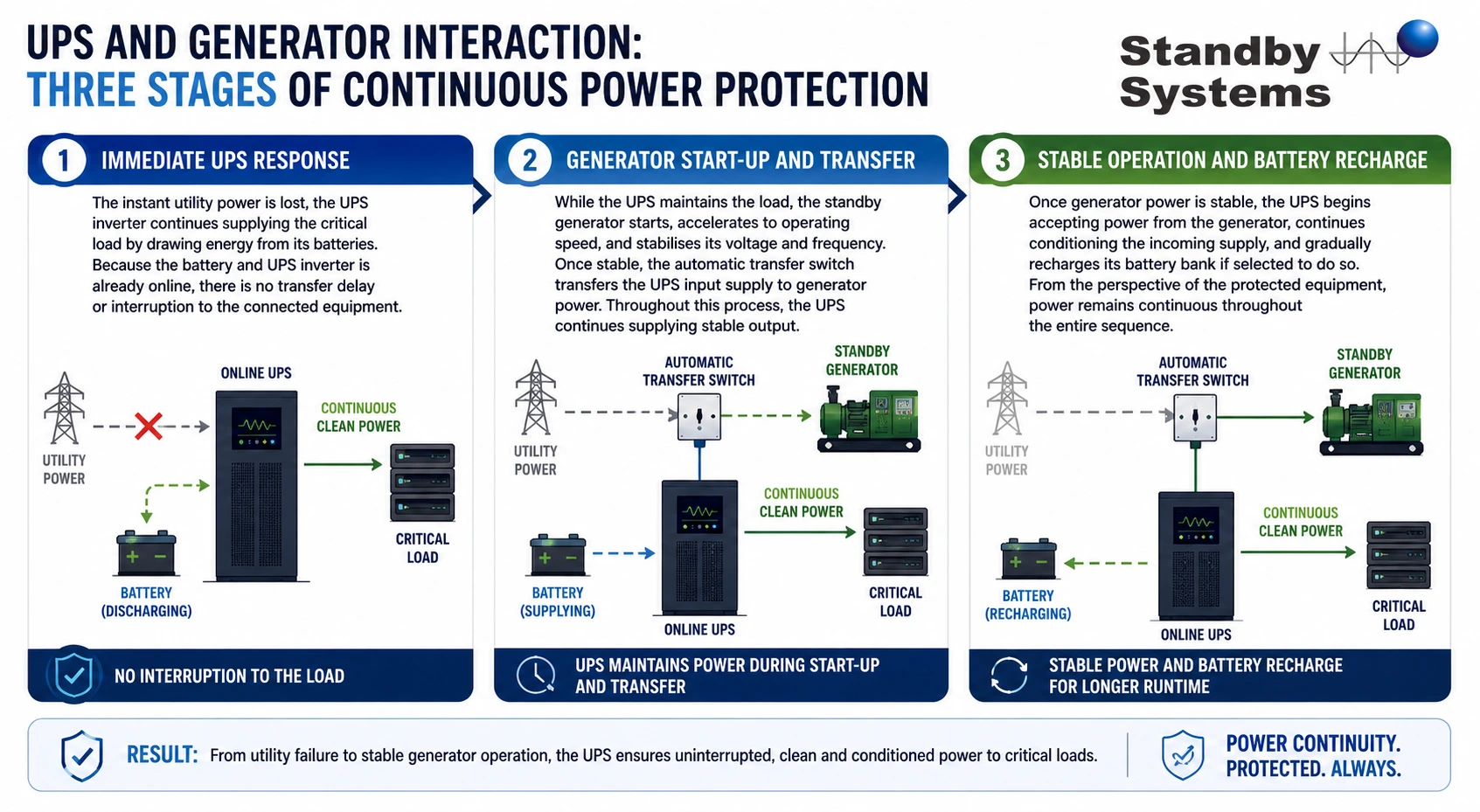
The instant utility power is lost, the UPS inverter continues supplying the critical load by drawing energy from its batteries. Because the battery and UPS inverter is already online, there is no transfer delay or interruption to the connected equipment.
While the UPS maintains the load, the standby generator starts, accelerates to its operating speed, and stabilises its voltage and frequency. Once these operating conditions have been achieved, the automatic transfer switch transfers the UPS input supply to generator power. Throughout this process, the UPS continues supplying stable output to the protected equipment.
Once generator power is stable, the UPS begins accepting power from the generator, continues conditioning the incoming supply, and gradually recharges its battery bank if selected to do so. From the perspective of the protected equipment, power remains continuous throughout the entire sequence.
The period between utility failure and stable generator operation is a particularly vulnerable window. In addition, other loads such as cooling loads, etc will cause step loading of the generator, resulting in generator speed variance, output frequency drift, and voltage instability.
Generator start-up, load acceptance, and transfer operations can introduce the following electrical disturbances that may affect sensitive equipment:
Many modern facilities rely on sophisticated electronics and microprocessor-controlled equipment. Whether managing automated process lines in logistics facilities and distribution centres, diagnostic suites, or data rooms in manufacturing facilities, these platforms are often far more sensitive to these transfer disturbances than traditional electrical loads. Even though the generator eventually successfully restores power to the building, short-term electrical disturbances can still disrupt critical operations.
The electrical characteristics of today’s facilities differ significantly from those of previous generations. Variable speed drives, switch-mode power supplies, industrial automation, data processing equipment, communications infrastructure, and LED lighting all present non-linear electrical loads that can influence generator performance. At the same time, these technologies are often less tolerant of voltage disturbances and frequency variations.
Modern online UPS systems are designed to manage these conditions by isolating critical equipment from fluctuations on the incoming supply while continuously delivering clean, stable power. This combination allows organisations to benefit from standby generation without exposing sensitive equipment to the electrical characteristics of the generator itself.
A common misconception is that once the generator is running and past the initial changeover, the UPS has little further role to play. In reality, generator output continues to vary as facility operating conditions change. Large motor starting currents, fluctuating production loads, and changing electrical demand can all influence voltage stability and frequency regulation. Although modern generators provide excellent performance, they are still constantly adjusting to changing site conditions.
An online UPS continues to isolate sensitive loads from these operating conditions by delivering a consistently regulated output. This continuous power conditioning improves equipment reliability, supports process continuity, and reduces the likelihood of nuisance trips or unexpected shutdowns while running on generator power.
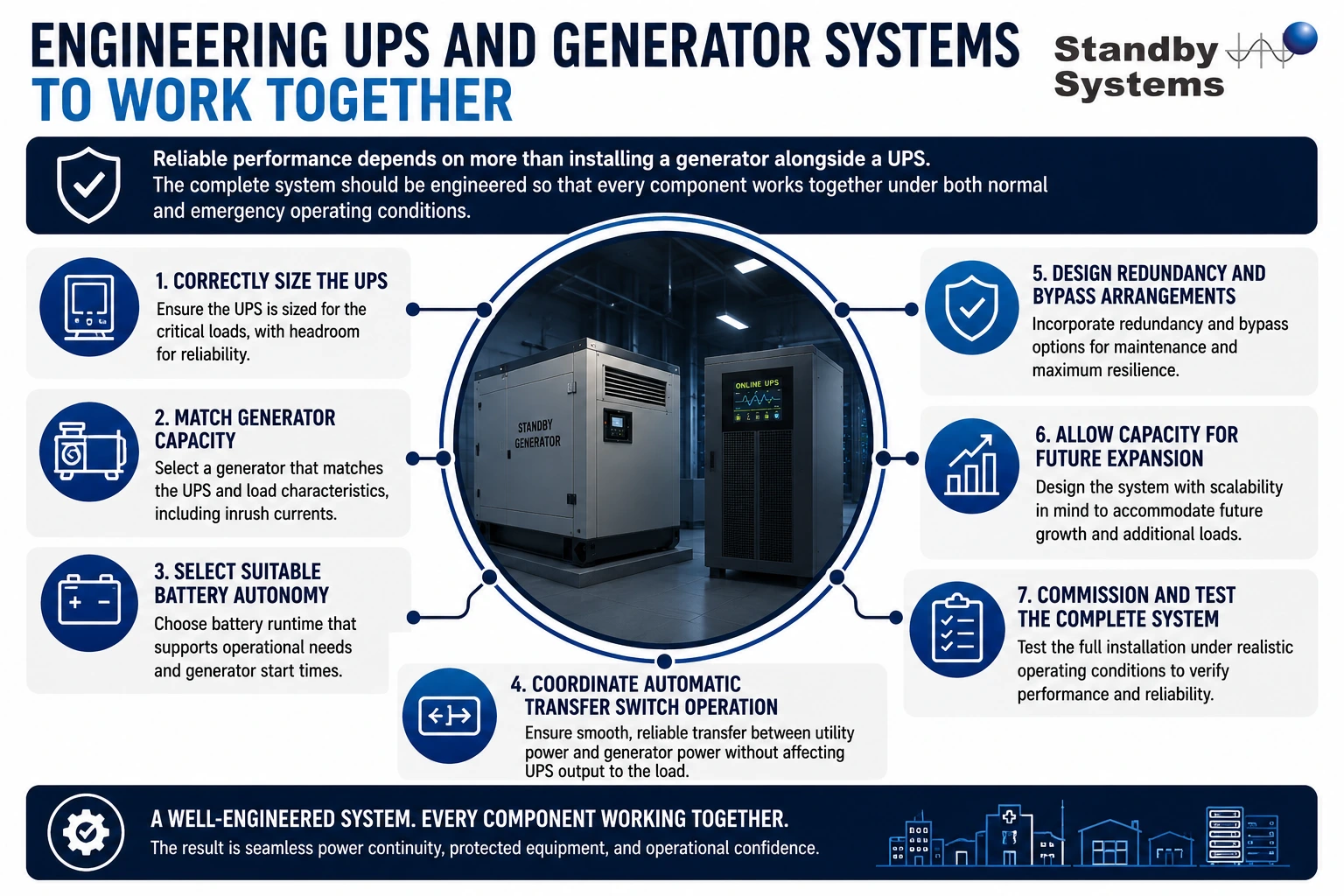
Reliable performance depends on more than installing a generator alongside a UPS. The complete system should be engineered so that every component works together under both normal and emergency operating conditions.
This includes:
Advances in modern UPS technology have significantly improved compatibility between online UPS systems and standby generators.
High input power factors between 0,8 to unity, reduced harmonic distortion of less than 3%, intelligent rectifier controls and design, and controlled battery charging enable today’s online UPS systems to operate more effectively with standby generators than earlier generations of equipment.
Considering these characteristics during system design can improve overall performance, improve generator response under changing load conditions, and help avoid unnecessary generator oversizing.
Every installation has different operational requirements. A hospital has different priorities from a manufacturing plant, while a computer or data room requires different levels of resilience from a mining operation. Engineering the complete system ensures that all components perform together when they are needed most.
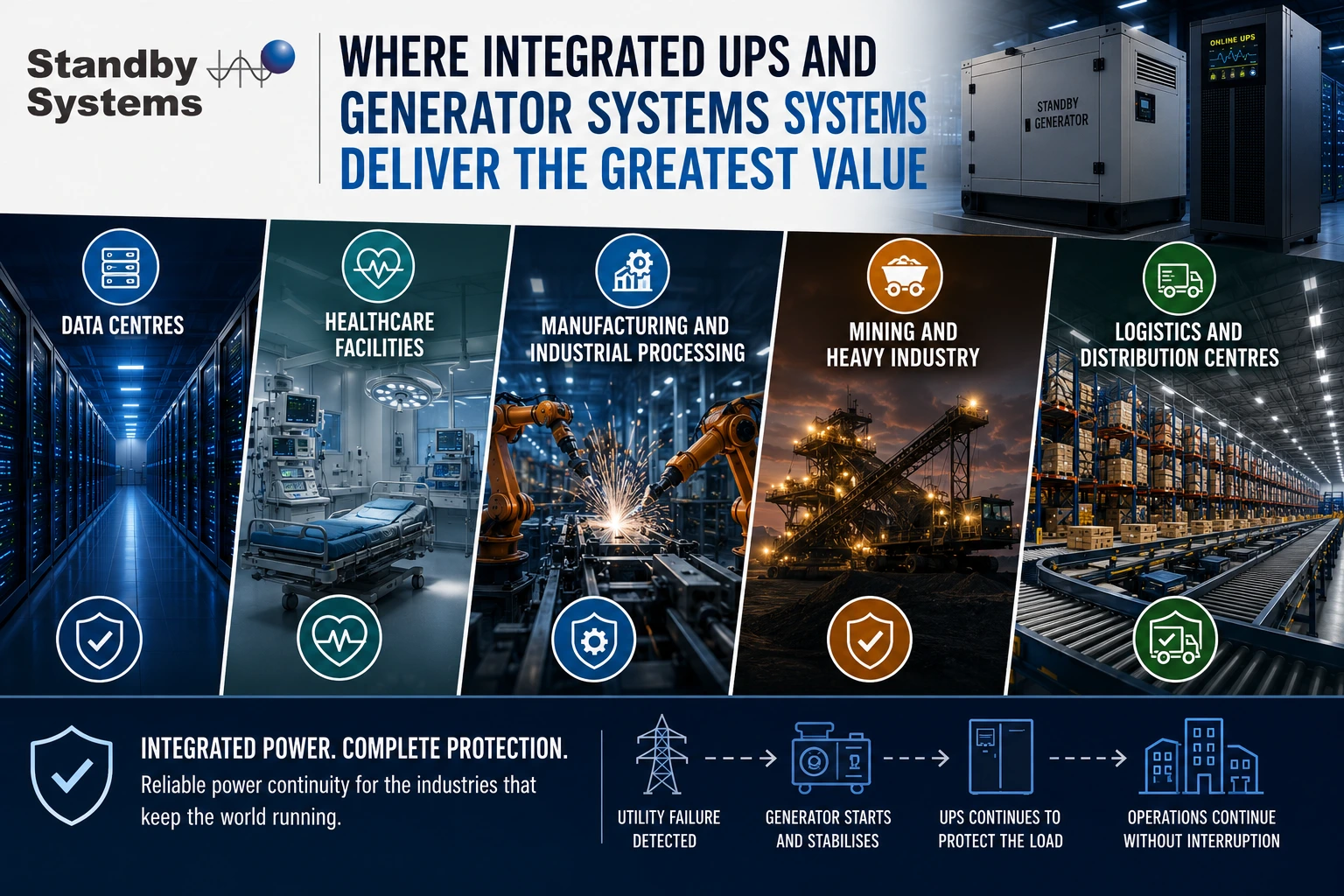
Servers, storage systems, networking equipment, and cooling controls require uninterrupted operation during utility failures. An online UPS bridges the transfer to generator power while maintaining stable voltage for equipment that cannot tolerate even brief interruptions. These UPS systems are required to have minimal impact on the supply source with extremely low power losses.
Medical imaging systems, patient monitoring equipment, operating theatres, and laboratory instrumentation rely on clean, stable power. The UPS isolates sensitive equipment from voltage sags and other disturbances that may occur during generator start-up and load transfer. These UPS units are often installed in the same room as the imaging equipment, making efficient use of floor space an important consideration. Imaging suites are highly specialised environments with significant construction costs, so compact equipment offers a practical advantage. Patient comfort is also important, making low audible noise another key design consideration.
Automated production lines, robotics, PLCs, and process control systems can experience costly downtime if electrical disturbances cause equipment to reset. Continuous UPS protection helps maintain production stability throughout generator changeovers.
Large motors, crushers, conveyors, and processing equipment create dynamic electrical loads that can influence generator performance. Online UPS systems protect critical control infrastructure and communications equipment from harmonic distortion and changing electrical conditions.
Warehouse management systems, robots, automated conveyor networks, barcode scanning, communications equipment, and distribution controls depend on continuous power to keep goods moving. Maintaining stable power during generator transitions helps prevent unnecessary operational interruptions.
Standby generators and online UPS systems perform different but complementary roles within a resilient power protection strategy. A generator restores electrical supply following a utility failure. An online UPS maintains continuous, conditioned power before, during, and after the transition while protecting sensitive equipment from the electrical disturbances that generators alone cannot eliminate.
Together, they deliver far more than backup power. They provide true power continuity, helping organisations protect critical infrastructure, reduce operational risk, and maintain business continuity whenever the utility supply becomes unreliable.
Understanding how online UPS systems and standby generators work together is just one part of designing a resilient power protection strategy. The following guides explore related topics in more detail:
Ensuring Uninterrupted Power and Power Quality in South Africa
Discover how power continuity and power quality work together to protect sensitive loads across South African industries.
20 Things You Need to Know About Three-Phase UPS Units
Learn how online double-conversion technology continuously delivers clean, stable power and why it is widely used to protect essential equipment.
Everything You Need to Know About UPS Batteries in South Africa
Explore the role of UPS batteries, compare VRLA and lithium technologies, and understand how battery selection influences system performance and reliability.
Whether you’re specifying a new installation or reviewing an existing power protection strategy, understanding how each component contributes to overall system resilience helps ensure reliable operation when utility power becomes unpredictable.
At Standby Systems, we engineer complete power protection solutions that integrate online UPS systems, standby generators, battery technologies, and monitoring systems into coordinated, reliable installations. From specification and system design through commissioning and long-term support, our focus is on delivering dependable power continuity for critical operations across South Africa and the SADC region.
For guidance on selecting the correct UPS/generator combination, contact Standby Systems.
Visit Standby Systems’ website or find us on Facebook, LinkedIn, Instagram, and YouTube.
Southern Africa is at a turning point with its power production, but we are not…
In this blog, we discover how UPS systems protect distribution centres, courier facilities, and warehouse…
In this blog, we uncover five more industries where power instability creates immediate operational risk.…
Standby Systems shares what SECUREX 2026 confirmed about UPS power protection in South Africa’s security…
In this blog, we investigate why industrial UPS batteries fail prematurely in South Africa, because…
In this blog, we investigate why UPS batteries require proper maintenance and replacement strategies in…