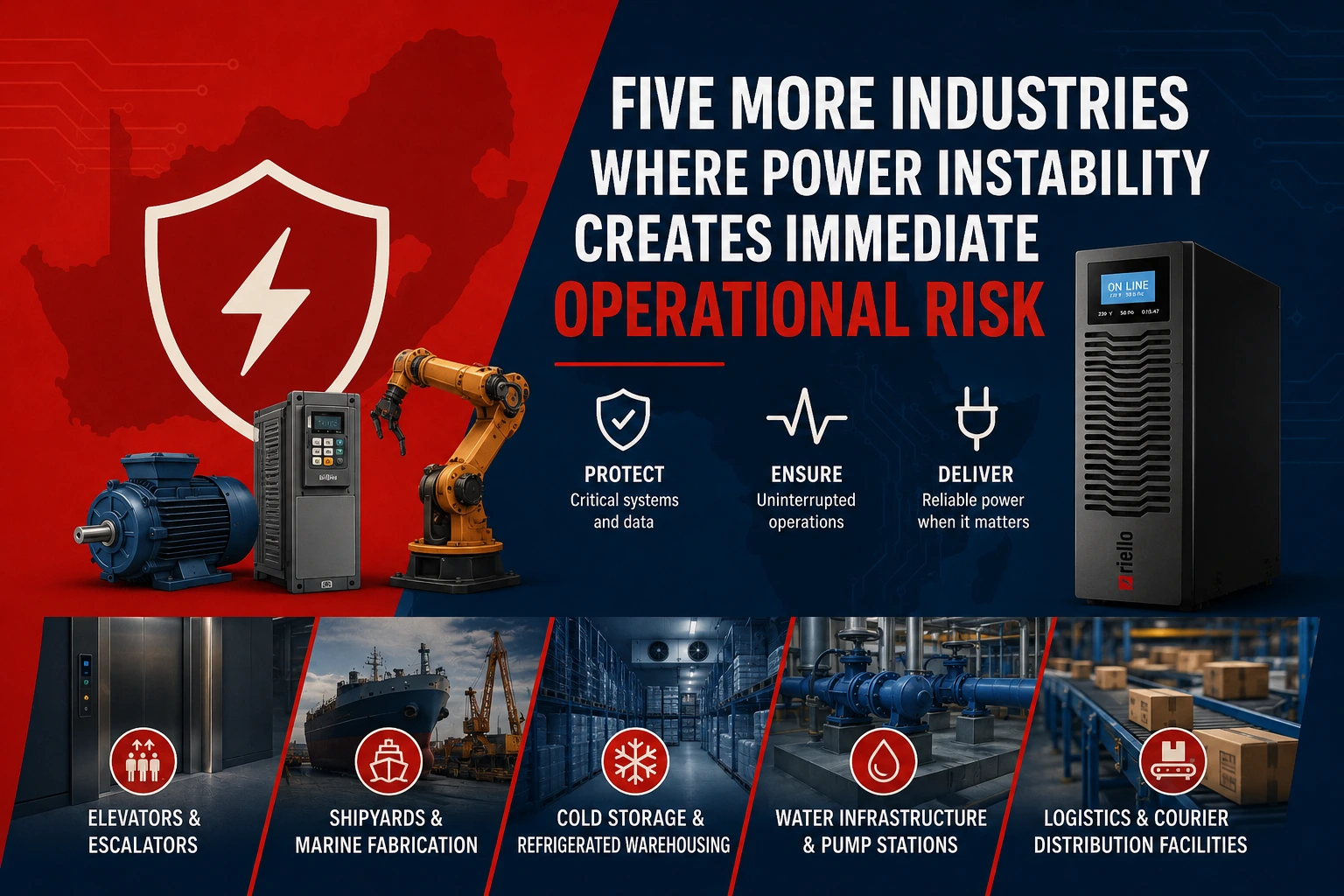
Industrial UPS infrastructure helps maintain stable operation across specialised sectors exposed to unstable utility supply, generator transitions, and power quality disturbances
In this blog, we uncover five more industries where power instability creates immediate operational risk.
Modern industrial facilities are increasingly dependent on automated controls, variable speed drives, PLC infrastructure, remote telemetry, electronic monitoring systems, and high-precision process equipment. In these environments, power failures are only part of the problem.
Voltage sag, harmonic distortion, frequency drift during generator step-over, regenerative loads, and transient instability routinely disrupt industrial operations long before a complete blackout occurs. Across South Africa and the broader Southern African region, unstable utility conditions and generator dependency are placing increasing pressure on industrial electrical infrastructure.
For many facilities, the operational risk is no longer simply losing power; it is maintaining a stable, conditioned electrical supply while sensitive automation systems continue operating under unstable grid and generator conditions.
Online double-conversion UPS systems, transformer-based UPS configurations, and properly designed industrial UPS infrastructure help isolate sensitive equipment from unstable electrical conditions while maintaining operational continuity during outages, generator transitions, and voltage disturbances.
While Standby Systems regularly works with large-scale environments such as data centres, hospitals, mining operations, and industrial manufacturing facilities, many less-publicised sectors face equally severe operational risks when power quality degrades. In many of these environments, operational continuity depends on sensitive electronic frameworks that cannot tolerate harmonic distortion, voltage instability, transient sag, or generator fluctuation.
The table below maps the specific power quality anomalies encountered in these niche sectors to their operational consequences and the required UPS topology.
| Industry | Primary Electrical Threat | Operational Consequence | Recommended UPS Approach | |
| Elevators and escalators | Regenerative braking loads and voltage instability | Controller faults, unsafe shutdowns, nuisance tripping | Three-phase online double-conversion UPS with regenerative load tolerance | |
| Shipyards and marine fabrication | Harmonics, non-linear loads, welding instability | CNC interruption, equipment faults, process inconsistency | Transformer-based industrial UPS with galvanic isolation | |
| Cold storage and refrigerated warehousing | Compressor inrush current and generator instability | Refrigeration trip-outs, compressor lockout, restart delays | Industrial UPS protecting PLC and control infrastructure | |
| Water infrastructure and pump stations | Voltage drop over long cable runs and transient events | Pump faults, telemetry interruption, VSD instability | Online double-conversion UPS with wide input voltage tolerance to buffer line drops without unnecessary battery discharge | |
| Logistics and courier distribution facilities | High-density automation loads and transient instability | Conveyor stoppages, sorting corruption, dispatch interruption |
|
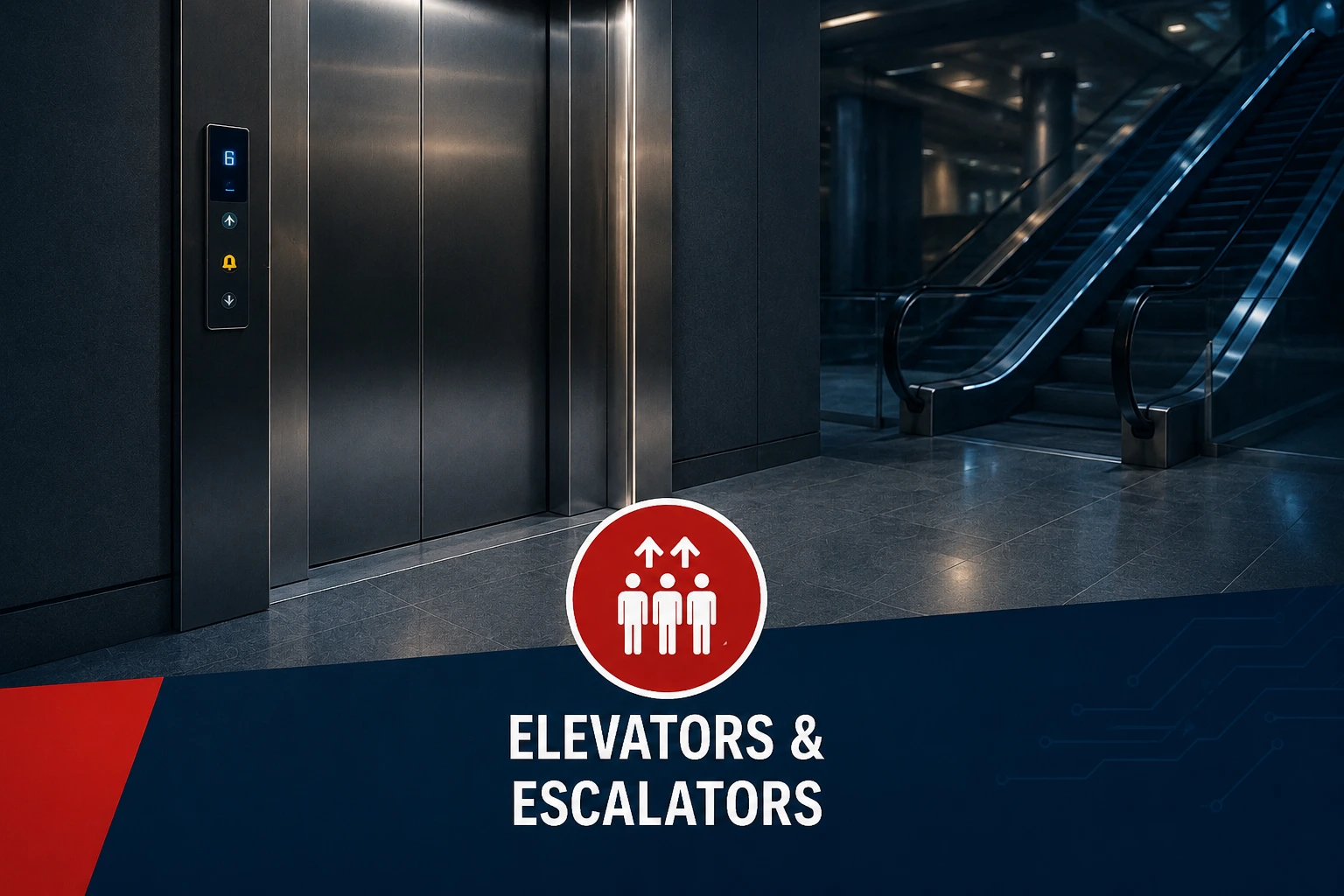
Modern elevator systems do considerably more than move passengers between floors. Most large installations rely on variable frequency drives, regenerative braking systems, electronic control platforms, automated safety infrastructure, and motor control electronics that are highly sensitive to unstable power quality.
During descent and braking, many modern elevators regenerate energy back into the electrical supply. If the surrounding electrical infrastructure is unstable, or if the UPS system is not designed to tolerate regenerative load behaviour, the returning energy can trigger inverter instability, nuisance tripping, or controller faults.
Generator transitions create additional challenges. Frequency drift and voltage sag during changeover frequently disrupt elevator controls before generator output stabilises. In commercial buildings, hospitals, and residential towers, these interruptions can trigger uncontrolled shutdown sequences and disable critical lift operation.
Three-phase online double-conversion UPS systems help isolate elevator control infrastructure from unstable incoming supply conditions while maintaining stable voltage and frequency regulation during grid disturbances and generator operation.
In larger facilities, UPS configuration often extends beyond the elevator drive itself to include emergency lighting systems, ventilation controls, access systems, communication infrastructure, and fire-response interfaces.
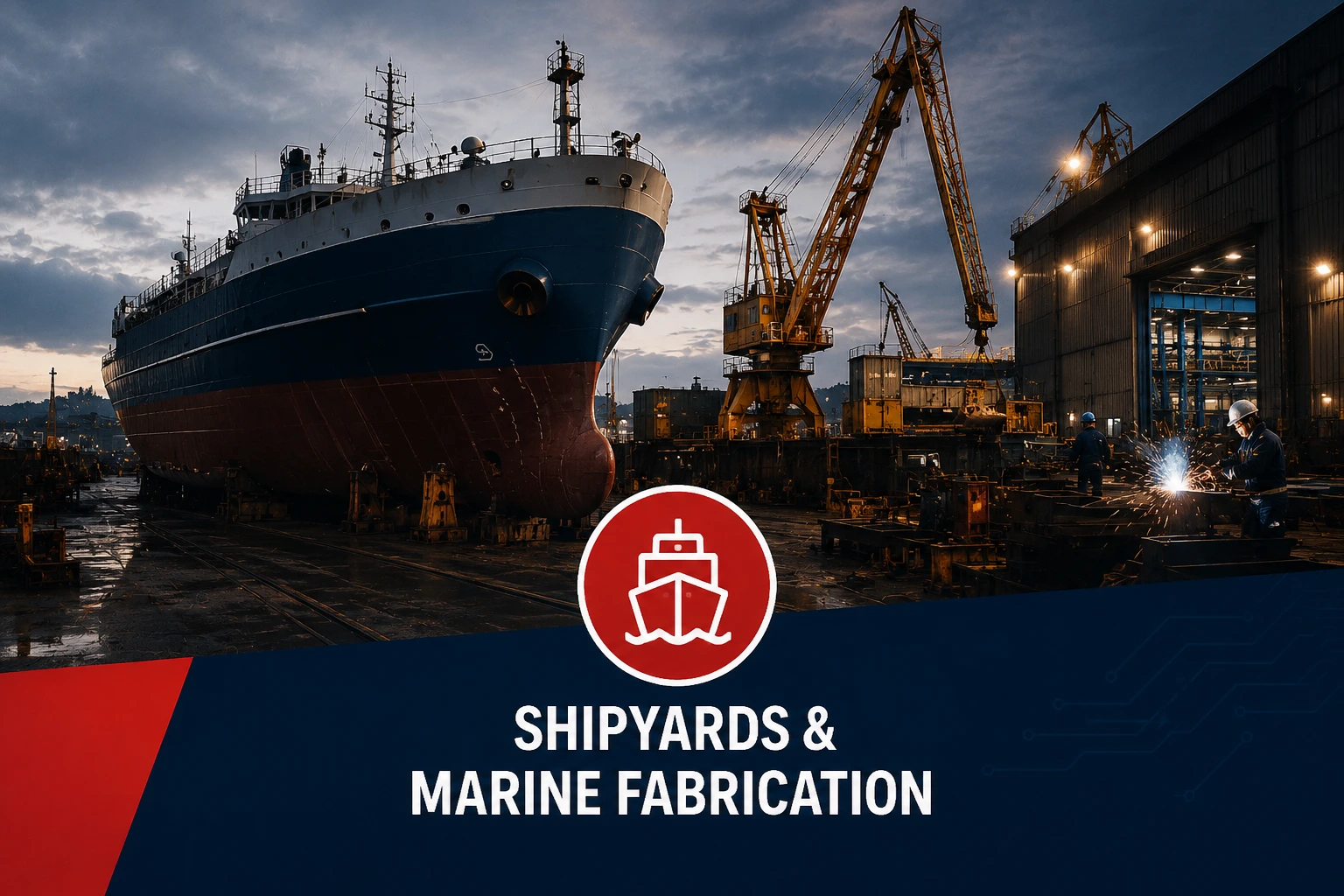
Shipyards and marine fabrication facilities place extreme demands on electrical infrastructure. Arc welding systems, plasma cutters, CNC machining centres, milling equipment, and heavy industrial motors introduce large non-linear loads that create harmonic distortion, voltage instability, and transient electrical stress throughout the facility.
Plasma cutting systems and welding equipment routinely generate rapid current fluctuations that destabilise sensitive control infrastructure sharing the same electrical environment. Without proper isolation, these disturbances propagate through the electrical network and trigger CNC interruption, controller faults, instrumentation instability, and process inconsistency.
Generator transitions introduce further instability, as large motor starts and fluctuating industrial loads create immediate voltage and frequency anomalies. In these environments, transformer-based industrial UPS systems such as the Riello Master MPS and Riello Master HP ranges provide galvanic isolation between sensitive automation infrastructure and electrically aggressive fabrication loads while improving tolerance to harmonics, transient spikes, electrical noise, and unstable generator conditions.
In marine and heavy industrial settings, the primary engineering objective of the UPS infrastructure is active power conditioning and control system protection, with battery runtime serving as a secondary consideration.
The same electrical conditions are common throughout mining facilities, process plants, manufacturing operations, and industrial production environments where large non-linear loads interact continuously with sensitive control systems.
Cold storage and refrigerated warehousing environments depend on tightly controlled refrigeration infrastructure operating continuously under high electrical demand.
The primary operational threat is often not complete product thawing during a short outage. The greater risk is electrical instability forcing refrigeration systems into fault conditions that require lengthy restart procedures and manual intervention.
Large refrigeration compressors draw substantial inrush current during startup, often reaching six to eight times normal running current. During generator step-over, voltage transients and frequency instability frequently trigger contactor drop-out, compressor lockout conditions, and PLC faults before refrigeration systems stabilise.
In ammonia-based refrigeration systems, these interruptions can force operators into extended purge and restart procedures that significantly outlast the original outage itself.
Voltage instability also damages refrigeration controllers, monitoring infrastructure, and electronic protection systems that maintain environmental compliance and operational visibility.
Industrial UPS systems and UPS batteries within refrigerated facilities are commonly configured to stabilise control infrastructure, PLC systems, environmental monitoring platforms, communication systems, and automation controls while heavy compressor loads remain supported by generator infrastructure.
This separation allows critical control systems to remain electrically stable even while large refrigeration loads transition between utility and generator supply.
Water treatment plants, pump stations, sewage infrastructure, borehole systems, and municipal distribution networks frequently operate across large geographical areas connected through long cable runs and remote telemetry infrastructure.
These environments are particularly vulnerable to voltage drop, transient instability, lightning-related disturbances, and generator fluctuation.
Long cable distances often introduce substantial voltage drop under heavy motor loading conditions. Variable speed drives controlling pump systems are especially sensitive to unstable supply conditions and regularly trigger nuisance tripping during transient events or unstable generator transitions.
When telemetry infrastructure loses stable power, operators lose visibility across remote facilities, affecting pressure management, flow monitoring, pump synchronisation, and fault detection capability.
Compact high-efficiency UPS systems such as Riello Sentrym are commonly used to protect SCADA infrastructure, telemetry systems, communication platforms, and remote monitoring equipment within distributed utility and water management environments.
In critical water infrastructure environments, redundant and parallelable UPS systems are frequently deployed to maintain operational continuity during maintenance activity or equipment failure.
For water utilities, preserving telemetry and SCADA functionality during a power event is just as critical as protecting the pump motors themselves. When visibility across geographically distributed infrastructure drops, localised faults can quickly escalate into widespread system failures.
Modern logistics and courier facilities operate as highly automated processing environments with significant equipment density and constant operational throughput.
Automated sorting conveyors, barcode scanning infrastructure, dispatch systems, warehouse management platforms, fleet communication systems, loading dock automation, refrigeration infrastructure, and tracking databases all depend on stable electrical supply conditions.
Even brief voltage sag events can halt conveyor synchronisation, corrupt sorting matrices, interrupt dispatch infrastructure, and trigger widespread automation faults across the facility.
In high-throughput logistics environments, restarting systems after an electrical event often takes substantially longer than the outage itself. Conveyor systems require recalibration, automation platforms require resynchronisation, and corrupted tracking processes may require manual intervention before operations normalise.
Generator transitions introduce additional instability into facilities operating large conveyor motors, automated handling systems, and continuous scanning infrastructure simultaneously.
Three-phase online double-conversion UPS systems help isolate critical automation and dispatch infrastructure from unstable electrical supply conditions while maintaining continuous operation during utility instability and generator transition events.
In larger facilities, UPS infrastructure often forms part of a broader operational resilience approach that includes generator integration, redundancy planning, remote monitoring capability, and segmented protection of critical automation layers.
Industrial facilities increasingly depend on electrical environments that remain stable under rapidly changing load conditions, generator operation, and unstable utility supply.
In many cases, hidden power quality phenomena, including voltage transients, harmonic distortion, frequency instability, regenerative feedback, and transient sag, cause far more operational disruption than outright blackouts by triggering continuous automation faults and nuisance tripping.
From marine fabrication and cold-chain logistics to municipal infrastructure and automated distribution facilities, properly designed UPS configuration has become a critical part of industrial operational resilience.
For guidance on selecting the correct UPS approach for demanding industrial, commercial, and infrastructure environments, contact Standby Systems.
Visit Standby Systems’ website, or find us on Facebook, LinkedIn, Instagram, and YouTube.
In our experience, we have encountered nine common UPS specification mistakes, so we put together…
In this blog, we detail why generator-supported loads still need online UPS protection. Many organisations…
Southern Africa is at a turning point with its power production, but we are not…
In this blog, we discover how UPS systems protect distribution centres, courier facilities, and warehouse…
Standby Systems shares what SECUREX 2026 confirmed about UPS power protection in South Africa’s security…
In this blog, we investigate why industrial UPS batteries fail prematurely in South Africa, because…