UPS battery maintenance and monitoring are critical for reliable backup power in South Africa’s unstable power environment.
In this blog, we investigate why UPS batteries require proper maintenance and replacement strategies in South Africa, where power disruptions are not limited to load shedding, and temperatures in some regions often exceed the battery-safe 25 °C.
Unplanned outages caused by grid instability, poor infrastructure maintenance, vandalism, and severe weather events continue to disrupt business operations across the country. As a result, backup power systems ought to be part of daily operations, yet many UPS systems still rely on battery banks that are neither maintained nor monitored and are not ready for repeated discharge cycles.
When the power goes out, that is when the real problem shows up.
A UPS system can run perfectly for months with no alarms or visible faults. However, when the grid drops and the system transfers to battery, failure can occur within seconds if the battery bank is compromised.
In most cases, the issue is not the UPS. It is the batteries.
UPS batteries do not degrade in a way that is easy to see. They lose capacity slowly, unevenly, and without obvious warning. A single weak cell can pull down an entire battery string, reducing runtime or causing the system to trip under load. This is similar to a heavy vehicle operating with one failed tyre. The rest of the system may be intact, but it cannot perform under pressure.
In environments where outages are frequent, such as South Africa and neighbouring regions, this risk is amplified. Batteries are expected to work repeatedly, but without proper management, they can’t.
Battery degradation is driven by operating conditions and how the system is managed over time. Temperature is one of the most significant factors affecting UPS VRLA AGM battery performance, particularly in warmer regions such as Botswana, Namibia, and parts of inland South Africa, where elevated ambient conditions accelerate internal chemical reactions.
Elevated temperatures have a direct and significant impact on the performance of UPS VRLA AGM batteries. Heat acts as a catalyst, increasing the reactivity of the battery electrolyte with the cell plates. This results in higher short-term power availability but also leads to increased charging currents under float conditions and significantly higher levels of gassing, even during normal operation. Under discharge or recharge conditions, this gassing effect becomes even more pronounced.
To mitigate this, many UPS systems incorporate temperature-compensated charging. In these systems, the UPS rectifier monitors the ambient temperature of the battery environment and automatically adjusts the charge voltage to maintain optimal operating conditions. These adjustments are based on manufacturer-specific calculations, but typically involve reducing the charge voltage by a set number of millivolts per degree Celsius above the optimal temperature range of 18 to 22 °C. This helps limit the catalytic effect of elevated temperatures and extends battery service life.
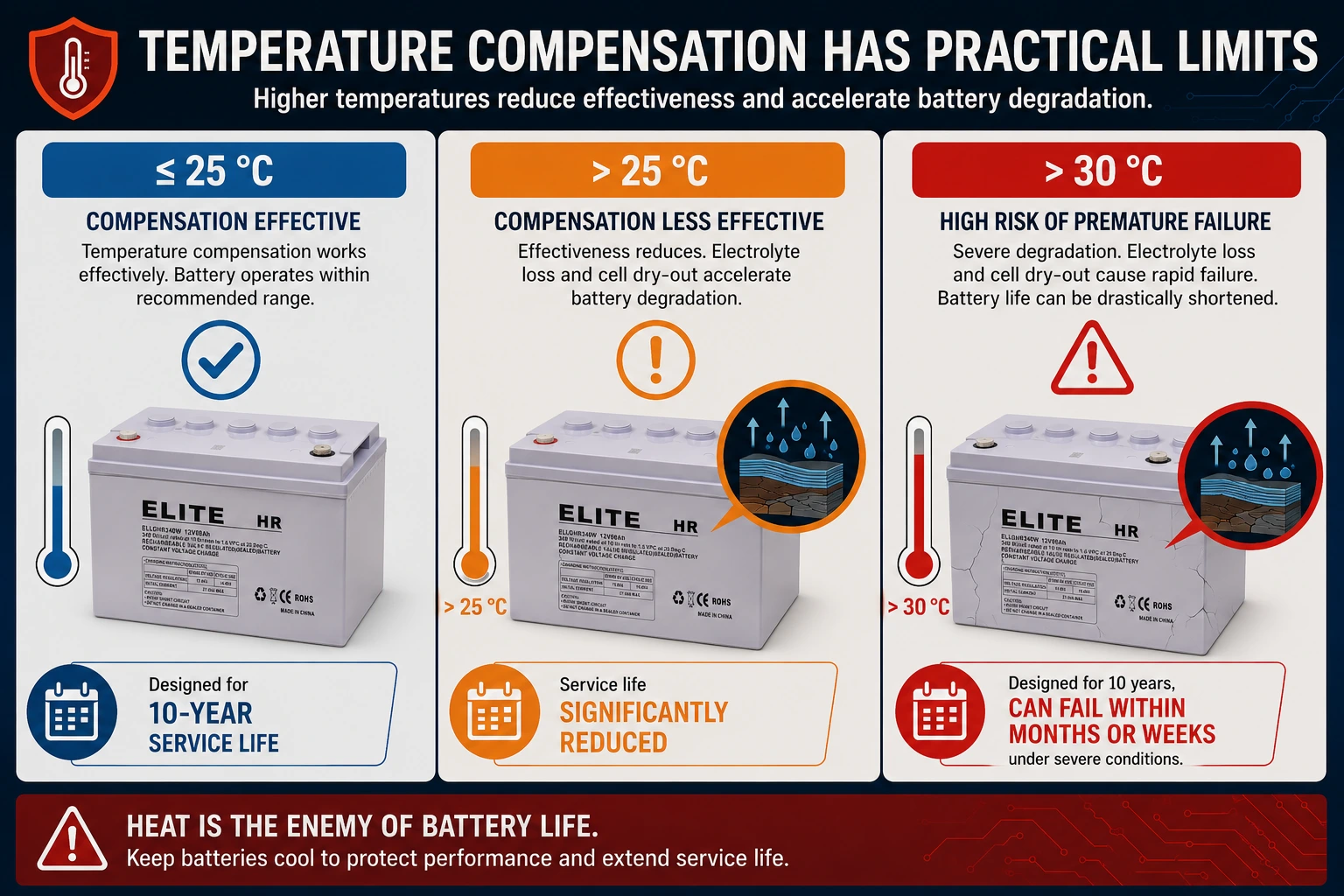
However, temperature compensation has practical limits. At sustained temperatures above 25 °C, the effectiveness of compensation reduces, and battery degradation accelerates due to electrolyte loss and cell dry-out. At temperatures exceeding 30 °C, a battery designed for a ten-year service life can fail within months, or even weeks, under severe conditions.
In contrast, low temperature effects are less common in the Southern African UPS environment but remain important. Lower temperatures reduce battery performance and require higher charge voltages to maintain full capacity. If temperature compensation is not applied, prolonged operation at low temperatures can result in undercharging, leading to sulphation and permanent capacity loss.
It is important to note that while low temperatures negatively affect performance during operation, they are beneficial for battery storage. Lower storage temperatures reduce the rate of self-discharge and extend shelf life, allowing for longer intervals between refresher charging.
Both sulphation at low temperatures and electrolyte loss due to excessive gassing at high temperatures increase internal cell impedance. As impedance rises, higher currents are required to achieve full charge. This generates additional heat, which further accelerates gassing and degradation. The result is a self-reinforcing cycle that can lead to thermal runaway, permanent capacity loss, and, in extreme cases, cell failure or fire.
Repeated discharge cycles place additional stress on the battery. In a stable grid environment, batteries may only be used occasionally. Under load-shedding conditions, they are used far more frequently, which changes the entire lifecycle profile.
A UPS battery is normally sized for occasional discharge, whereas regularly cycled battery banks are designed with different parameters, including higher cut-off voltages, increased charge rates, and shorter service life expectations.
Maintenance practices often lag behind this reality. Batteries are installed, commissioned, and then left with minimal follow-up. Without structured testing, early signs of failure remain hidden. The result is predictable. Performance drops quietly, and failure only becomes visible when the system is under load, and often, it’s at the most inconvenient time.
UPS battery maintenance is the only reliable way to understand how the system will perform during an outage. A proper maintenance programme measures battery condition over time, identifies cells that are drifting out of tolerance, detects connection issues, and tracks the gradual increase in internal resistance.
This approach replaces assumption with evidence. Without it, decisions are based on age alone, which is rarely accurate. Two battery banks installed at the same time can perform very differently depending on temperature, usage, and operating conditions.
If your UPS supports critical operations, maintenance forms part of the system, not an optional add-on.
Waiting for batteries to fail before replacing them introduces unnecessary risk. By the time failure occurs, systems shut down, production stops, and sensitive equipment is exposed to unstable power.
A more effective approach is to use performance data to guide replacement timing. When battery condition is monitored properly, it becomes possible to see when capacity is dropping below acceptable levels. Replacement can then be scheduled while the system is still stable, avoiding both premature replacement and unexpected failure. The objective is not to maximise battery lifespan at all costs, but to ensure the system performs when it is required.
Batteries are the most common failure point, but they are not the only ageing component in a UPS system. Capacitor banks play a critical role in electrical filtering, helping maintain stable voltages within the UPS.
As they degrade, capacitor banks begin to affect overall UPS performance, increasing heat generation, degrading power quality, and introducing electrical noise into the rectifier and inverter stages and their respective waveforms. This can lead to system instability and contribute to battery degradation, as higher-than-acceptable superimposed AC ripple voltage and current are imposed on the battery during charging, accelerating the ageing process.
In older systems, capacitor failure can be just as disruptive as battery failure. A complete maintenance strategy needs to account for both, as focusing on one while ignoring the other leaves a gap in system reliability.
Manual inspections alone are not sufficient in modern UPS environments. Continuous monitoring provides visibility into how the system behaves between maintenance intervals, allowing early detection of changes in battery condition.
This is particularly important in facilities that cannot afford downtime, including hospitals, industrial plants, and data-driven operations. With proper monitoring in place, maintenance becomes proactive rather than reactive, and problems can be addressed while there is still time to act.
Battery replacement does not have to disrupt operations. In well-managed environments, redundant UPS systems, power supplies, or battery solutions can be used to maintain power during maintenance. This allows critical systems to remain online throughout the process and ensures continuity during planned interventions.
For highly critical UPS systems, redundancy through monolithic UPS units, combined with parallel battery strings that are individually fused and isolated, enables “hot work” or battery replacement without requiring a system shutdown. By isolating one battery string at a time, load uptime is maintained even during a power failure.
Battery performance is closely tied to the type of UPS system in use. Different UPS configurations place different demands on the battery bank, which directly affects lifespan, discharge behaviour, and overall reliability.
In industrial, mining, data centre, and high-load environments, three-phase UPS systems are typically used to support larger and more complex electrical loads. Systems such as the Riello Master MPS UPS are designed to handle these conditions while maintaining stable output, but they rely on properly sized and maintained battery banks to deliver full performance during outages.
In more compact or controlled environments, such as smaller IT and medical facilities or commercial applications, systems like the Riello Sentryum UPS offer high-efficiency, online double-conversion performance with flexible battery configurations. These systems still depend on consistent battery maintenance to ensure reliable operation.
In all cases, the relationship between the UPS and the battery bank is critical. A well-designed UPS system will only perform as intended if the batteries supporting it are correctly specified, monitored, and maintained.
Battery performance sits at the centre of any UPS system, but it cannot be managed in isolation. It needs to align with the overall UPS configuration, the operating environment, and the maintenance strategy.
For a broader view of how UPS systems should be specified and applied in South African conditions, explore Ensuring Uninterrupted Power Supply in South Africa with Standby Systems.
If you need a deeper understanding of battery types and configurations, see Everything You Need to Know About UPS Batteries in South Africa.
UPS batteries do not fail because they are unreliable. They fail because they are assumed to be reliable. Once that assumption is replaced with measurement, monitoring, and planning, the entire system becomes more predictable. In an environment defined by power instability, that predictability is what matters.
If you are unsure about the condition of your UPS batteries, now is the time to address it. A proper assessment will give you a clear understanding of battery health, remaining life, and the risks within your system. Contact Standby Systems to arrange a battery evaluation and ensure your UPS system performs when required, or speak to us about developing a power protection approach that aligns with your facility, processes, and operational priorities.
Visit Standby Systems’ website, or find us on Facebook, LinkedIn, Instagram, and YouTube.
In our experience, we have encountered nine common UPS specification mistakes, so we put together…
In this blog, we detail why generator-supported loads still need online UPS protection. Many organisations…
Southern Africa is at a turning point with its power production, but we are not…
In this blog, we discover how UPS systems protect distribution centres, courier facilities, and warehouse…
In this blog, we uncover five more industries where power instability creates immediate operational risk.…
Standby Systems shares what SECUREX 2026 confirmed about UPS power protection in South Africa’s security…