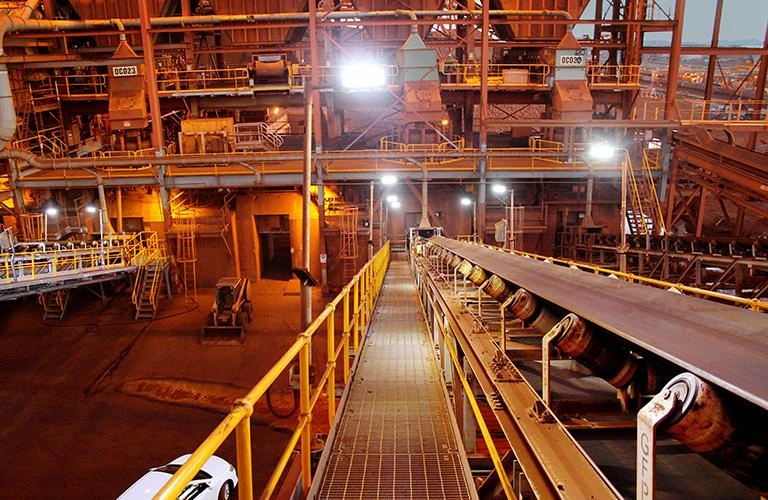
Three-phase UPS systems from Standby Systems provide stable, continuous power protection for manufacturing facilities across South Africa and Southern Africa.
In this blog, we explore how power instability damages manufacturing facilities and how to protect your industrial equipment.
In manufacturing environments, power instability rarely shows up as a single dramatic failure. It works quietly in the background, degrading equipment, disrupting processes, and slowly eroding production reliability.
Across Southern Africa, where grid conditions can be inconsistent, this is an everyday operational reality. Facilities that rely on a stable electrical supply for motors, control systems, and automated lines are particularly exposed. By the time failures become visible, the underlying damage has often been building for months.
Manufacturing plants operate a mix of heavy and sensitive loads. Large motors, compressors, and heating systems sit alongside PLCs, sensors, and control boards. All of these depend on a stable voltage supply, even if their tolerance levels differ.
Voltage fluctuations typically originate from:
These fluctuations do not need to be extreme to cause damage. Small, repeated deviations are often more harmful because they go unnoticed while steadily impacting performance.
Voltage instability affects equipment in ways that are not always immediately obvious.
Motors may run hotter than intended, insulation begins to degrade, and electronic components experience irregular stress. Control systems become unpredictable, leading to nuisance trips or inconsistent operation.
At the same time, systems often draw more current to compensate for poor voltage conditions. This places additional strain on already stressed components.
The result is a gradual decline in reliability. Equipment does not necessarily fail all at once. Instead, performance drops, faults become more frequent, and maintenance teams spend more time reacting than planning.
From a production perspective, the consequences are rarely isolated.
A voltage disturbance affecting one part of a process can interrupt an entire production line. Restarting systems takes time, particularly where sequencing or temperature control is involved. In some cases, partially processed products must be discarded.
Over time, this leads to:
These are not always attributed directly to power quality, which is why the root cause is often overlooked.
Pro Tip from Standby Systems
In many manufacturing facilities, the first signs of power instability show up as “random” equipment faults or nuisance trips rather than full failures. If your maintenance team is repeatedly resetting drives, replacing control components, or investigating intermittent issues without a clear cause, it is often worth reviewing your incoming power quality. Addressing voltage instability early can prevent a much larger pattern of equipment degradation and production disruption.
High-precision three-phase voltage stabilisers address one part of the problem by regulating incoming supply and maintaining a consistent output voltage.
This improves operating conditions for motors and control systems, supports more stable performance, and reduces unnecessary electrical stress.
However, stabilisers operate only while power is present.
When supply is interrupted completely, voltage regulation is no longer relevant. Production stops, systems shut down, and processes are disrupted regardless of how stable the voltage was beforehand.
This is where many facilities fall short. Voltage stability is addressed, but continuity is not.
In practice, protecting a manufacturing facility requires two things:
This is achieved by combining voltage stabilisation with industrial UPS systems.
In facilities where efficiency, footprint, and advanced monitoring are priorities, a Riello Sentryum three-phase UPS system offers a high-performance solution for maintaining clean, stable, and continuous power.
An online double-conversion UPS continuously conditions incoming power and provides immediate backup during outages. The performance and reliability of a UPS system also depend heavily on UPS battery performance and reliability, which plays a critical role in ensuring continuous operation during power interruptions. Equipment is supplied with a clean, uninterrupted output, regardless of what is happening upstream.
Manufacturing environments place specific demands on a UPS system design.
Loads are often mixed, with large inductive equipment operating alongside sensitive electronics. Electrical conditions may be harsh, particularly in facilities with heavy machinery or variable processes.
Industrial three-phase UPS systems are designed to handle these conditions. They provide:
For more demanding applications, transformer-based systems such as the Riello Master MPS industrial UPS system are well suited to handling large motors and complex load profiles while maintaining stable power delivery.
Standby Systems works with manufacturing facilities across South Africa, Namibia, Angola, Botswana, Zimbabwe, Mozambique, Lesotho, Eswatini, and Malawi.
Each environment presents its own challenges, but the objective remains the same. Keep equipment running as intended, reduce unplanned interruptions, and maintain consistent production.
Power quality issues in manufacturing are rarely solved with a single intervention. Addressing voltage alone leaves facilities exposed to outages. Focusing only on backup power ignores the long-term effects of an unstable supply.
A considered approach that combines voltage stabilisation with a properly specified UPS system design provides a more reliable foundation for production.
Speak to us about developing a power protection approach that aligns with your facility, your processes, and your operational priorities.
Visit Standby Systems’ website, or find us on Facebook, LinkedIn, Instagram, and YouTube.
In our experience, we have encountered nine common UPS specification mistakes, so we put together…
In this blog, we detail why generator-supported loads still need online UPS protection. Many organisations…
Southern Africa is at a turning point with its power production, but we are not…
In this blog, we discover how UPS systems protect distribution centres, courier facilities, and warehouse…
In this blog, we uncover five more industries where power instability creates immediate operational risk.…
Standby Systems shares what SECUREX 2026 confirmed about UPS power protection in South Africa’s security…