Riello three-phase UPS technology delivers reliable backup power for data centers and IT infrastructure across South Africa and Southern Africa.
Across South Africa and the broader Southern African region, including Namibia, Angola, Botswana, Zimbabwe, Mozambique, Lesotho, Eswatini, and Malawi, the demand for reliable data infrastructure has grown over the last few years at a rapid rate. This is why three-phase UPS systems South Africa data centres depend on have become essential for maintaining performance and uptime. With this increase in digital activity comes a higher need for dependable power protection. At the centre of this is most likely a three-phase UPS system, an important piece of equipment that ensures uninterrupted operations for data centres or similar environments.
Data centres cannot afford downtime! Even a brief power interruption can lead to data loss, hardware damage, or disrupted services. That is why a three-phase UPS unit is crucial.
With over 20 years of experience, Standby Systems has the expertise to answer your most common questions about three-phase UPS systems. In this guide, we explain why three-phase UPS systems are essential for data centre operations and highlight three top-performing UPS units we recommend, and why they stand out.
The meaning of UPS is Uninterruptible Power Supply, a system designed to provide continuous power during power outages, brownouts, or voltage fluctuations. A three-phase UPS distributes power evenly across three phases, enabling it to handle much larger power loads than a single-phase UPS. While a single-phase UPS is sufficient for small offices or individual servers, data centres, hospitals, commercial buildings such as banks, and industrial environments require a three-phase UPS unit that delivers high capacity, stability, and efficiency simultaneously, such as the AROS Riello NextEnergy UPS.
This is one of the main reasons three-phase UPS systems South Africa relies on are the preferred choice for modern data centre loads. Data centres handle enormous workloads across multiple racks of servers, cooling systems, and networking equipment. A single-phase UPS unit cannot manage such demanding loads. Three-phase UPS systems provide balanced power distribution, support high-density equipment, and reduce strain on the electrical infrastructure. This makes it the only viable choice for medium to large data centres across South Africa and neighbouring countries.
A three-phase UPS provides exceptional efficiency and stability. It offers continuous UPS backup during power outages and protects sensitive IT equipment from voltage fluctuations. The consistent power supply prevents data corruption and downtime. Furthermore, modern industrial UPS units feature advanced monitoring and control options that allow real-time management of energy use and performance. In regions such as Angola, Zimbabwe, and Malawi, where the power grid can be even more unreliable, these benefits are essential to maintain service continuity.
Most data centres in Southern Africa rely on online double-conversion technology. In this setup, incoming AC power is first converted to DC and then back to clean, stable AC power. This process isolates connected equipment from surges, frequency variations, and other electrical noise on the input supply from the electrical power grid. The UPS batteries automatically supply power without interruption to the connected load when the grid fails, ensuring no data or operations are lost. Once mains power returns, the system recharges the batteries and resumes normal operation without interruption.
Three-phase UPS units can range from 10 kVA units used in smaller commercial settings to large-scale installations of up to 6,4 MW for major data centres or industrial plants. The right size depends on the total connected load and desired UPS backup runtime. At Standby Systems, we offer expert assessments to ensure that every client in South Africa and across the Southern African region receives a properly sized system with sufficient batteries for their operational requirements.
A 3/3 UPS has a three-phase input and three-phase output, making it ideal for balanced loads such as server rooms and data halls. A 1/1 UPS has a single-phase input and single-phase output, suitable for smaller facilities with lighter equipment. By contrast, a 3/1 UPS (three-phase input with single-phase output) can cause load imbalance on both the supply grid and generator when operating in static bypass mode, making it less desirable. For loads above 20 kVA, a 3/3 UPS is preferred because it draws balanced power across all three input phases.
When selecting between configurations, the decision depends on the site’s electrical design, load distribution, and power management strategy. For single-phase applications up to 10 kVA, a 1/1 UPS is the ideal choice. Above 10 kVA, a single-phase rectifier generates higher battery ripple current, which can shorten battery service life. A three-phase rectifier, however, produces significantly less ripple voltage, resulting in better battery charging performance and extended battery life span.
Phase imbalance occurs when one phase carries a heavier load than the others. This can lead to overloading of the UPS on a single phase while the remaining phases carry minimal load, resulting in operational inefficiency and potential equipment stress. To manage this, industrial three-phase UPS systems require balanced load distribution across all three output phases. This involves shifting load circuits from one phase to another, a task that must be carried out by a qualified site electrician. Regular maintenance, load monitoring, and professional system design are essential to ensure long-term reliability and optimal performance across all three phases.
Redundancy is essential in data centre environments. Most installations use configurations such as N+1 or N+2, where all UPS modules share the connected load equally. If one UPS experiences a fault, its load share is automatically redistributed among the remaining units in equal portions, ensuring continuous operation. In addition, maintenance bypass circuits and wrap-around distribution boards allow technicians to service the UPS system without interrupting power to the servers. They also enable full system replacement at the end of the unit’s life span without shutting down the connected data centre loads.
These features guarantee uninterrupted operation even during maintenance or component failure, providing a secure UPS backup that keeps data centres online 24 hours a day, 7 days a week, with up to 99.9999% availability.
Modern three-phase UPS units, such as those manufactured by Riello UPS and supplied by Standby Systems South Africa, achieve efficiency ratings of up to 98%. This high level of performance minimises energy waste and reduces overall operational costs. In regions such as South Africa, Eswatini, and Mozambique, where electricity prices continue to rise, investing in an energy-efficient UPS can deliver significant long-term savings.
In addition, the improved power factor of these advanced systems ensures true power consumption with minimal distortion of the supply voltage waveform. This results in much lower harmonic injection back into the mains supply, reducing strain on the electrical network and supporting more sustainable energy management.
Choosing the right three-phase UPS systems South Africa organisations need requires understanding load profile, redundancy, and long-term support. In Southern Africa, it’s vital to partner with a provider that offers both regional expertise and dependable local support. Standby Systems brings over 200 years of combined experience in three-phase UPS systems and backup power solutions across South Africa, Namibia, Angola, Botswana, Zimbabwe, Mozambique, Lesotho, Eswatini, and Malawi. With a large inventory of UPS units, batteries, and spare parts, and a highly skilled technical team, Standby Systems delivers reliable end-to-end service in Southern Africa for data centre backup, industrial, and commercial power protection, from system design and installation to ongoing maintenance and support.
Without a dependable UPS backup system, even a brief power failure can lead to costly downtime, data loss, and hardware damage, all of which can harm your data centre’s reputation. A three-phase UPS system ensures continuous operation during power cuts, voltage fluctuations, and grid instability. In regions where load shedding and load reduction remain common, a robust industrial UPS system like the Riello Master MPS, paired with long-lasting VRLA (Valve-Regulated Lead-Acid) or increasingly popular lithium-ion batteries, provides a reliable recipe for continuous backup power.
Learn more about why UPS systems remain a smart investment in our article: Why UPS Systems Remain an Important Investment for Businesses Despite Reduced Load Shedding Frequency.
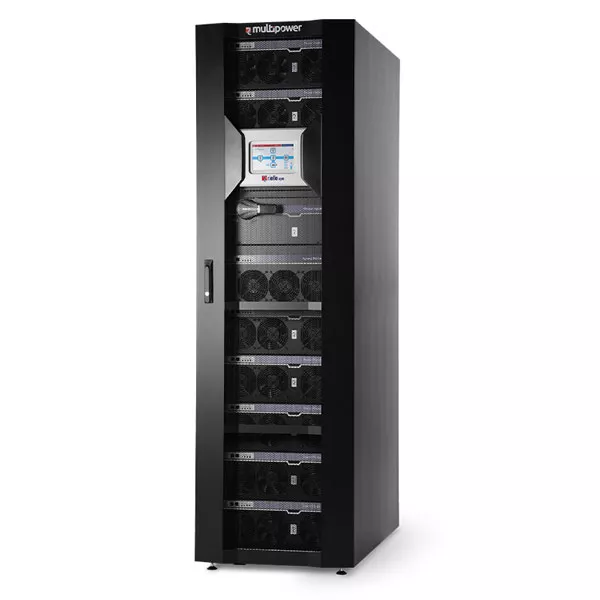
The Riello Multi Power range (MPW) is one of the most modular three-phase UPS systems designed specifically for data centres. It offers exceptional scalability, allowing power capacity to expand as demand grows. With efficiency levels of up to 98% in online mode and 99% in ECO mode, it ensures minimal energy waste. The modular design also provides redundancy and simplified maintenance, making it ideal for large-scale data centre environments across South Africa, Namibia, and Botswana.
Find out more information about the latest Multi Power in our blog: Riello UPS Launches Multi Power2: Modular UPS Solution for Modern Data Centre Infrastructures.
The Riello Sentryum is a versatile and compact industrial-grade UPS system suitable for medium-sized data centres, server rooms, and IT infrastructure. Built using advanced online double-conversion technology, it provides clean, stable power under all grid conditions. Its user-friendly interface, flexible battery configuration, and robust performance make it an ideal choice for data centres operating in environments with frequent voltage disturbances, such as those found in Mozambique, Zimbabwe, and Angola.
The Riello Master HP is a high-performance three-phase industrial UPS designed for large mission-critical facilities and enterprise-level data centres. It delivers top-tier reliability with transformer-based isolation and outstanding short-circuit handling capabilities. The Master HP range is ideal for environments where uptime is non-negotiable, such as major data centres in South Africa, Eswatini, and Malawi.
Across Southern Africa, data centres trust Standby Systems to deliver and maintain efficient, reliable UPS solutions. Whether your organisation is setting up a new facility or upgrading an existing power infrastructure, our range of Riello three-phase UPS units ensures uninterrupted power, operational stability, and long-term efficiency.
Our experienced technical team is ready to advise you on the best UPS unit and battery solutions for your data centre or industry’s needs, and to assist with servicing your UPS. Visit Standby Systems’ website or contact us at 011 794 3406 for services, 011 794 2541 for UPS systems for sale, or our UPS contact number at 082 450 2361.
In our experience, we have encountered nine common UPS specification mistakes, so we put together…
In this blog, we detail why generator-supported loads still need online UPS protection. Many organisations…
Southern Africa is at a turning point with its power production, but we are not…
In this blog, we discover how UPS systems protect distribution centres, courier facilities, and warehouse…
In this blog, we uncover five more industries where power instability creates immediate operational risk.…
Standby Systems shares what SECUREX 2026 confirmed about UPS power protection in South Africa’s security…